What would happen if a speaker played in a perfect vacuum? The cone could still move, but there would be no air molecules to pass its vibration onward. Sound needs matter because it travels as coordinated motion among particles. In air, liquid, or a solid, one small displacement changes pressure nearby, and that change propagates. This physical requirement connects an everyday voice to the fluid-filled inner ear and to medical ultrasound.
A disturbance moves; the material mostly stays
Sound is a mechanical wave: a pattern of compression and expansion that travels through a material. Picture a row of people standing shoulder to shoulder. One person nudges the next; the nudge travels along the row even though each person remains near their original place. In air, molecules collide and interact, passing along regions of slightly higher and lower pressure. The wave’s energy moves across the room while the air itself does not stream from speaker to listener.
In a vacuum there are no particles to compress or push on neighboring particles, so an acoustic wave cannot propagate. This differs from light, which is electromagnetic radiation and can cross empty space. Sound speed depends on the material’s properties, including how readily it compresses and how much inertia it has. Solids can carry sound too: a knock on a table reaches an ear through the table and then the surrounding air, by a different route than a voice traveling directly through air.
Frequency and pitch are features of the wave
A sound source vibrates at some rate. Frequency counts cycles per second and is measured in hertz; a higher frequency is usually heard as a higher pitch. Human hearing spans only part of the acoustic range. Ultrasound refers to sound above the threshold of human hearing, while medical probes commonly operate at frequencies in the megahertz range [2]. The wave remains mechanical even when its frequency is far too high for a person to hear.
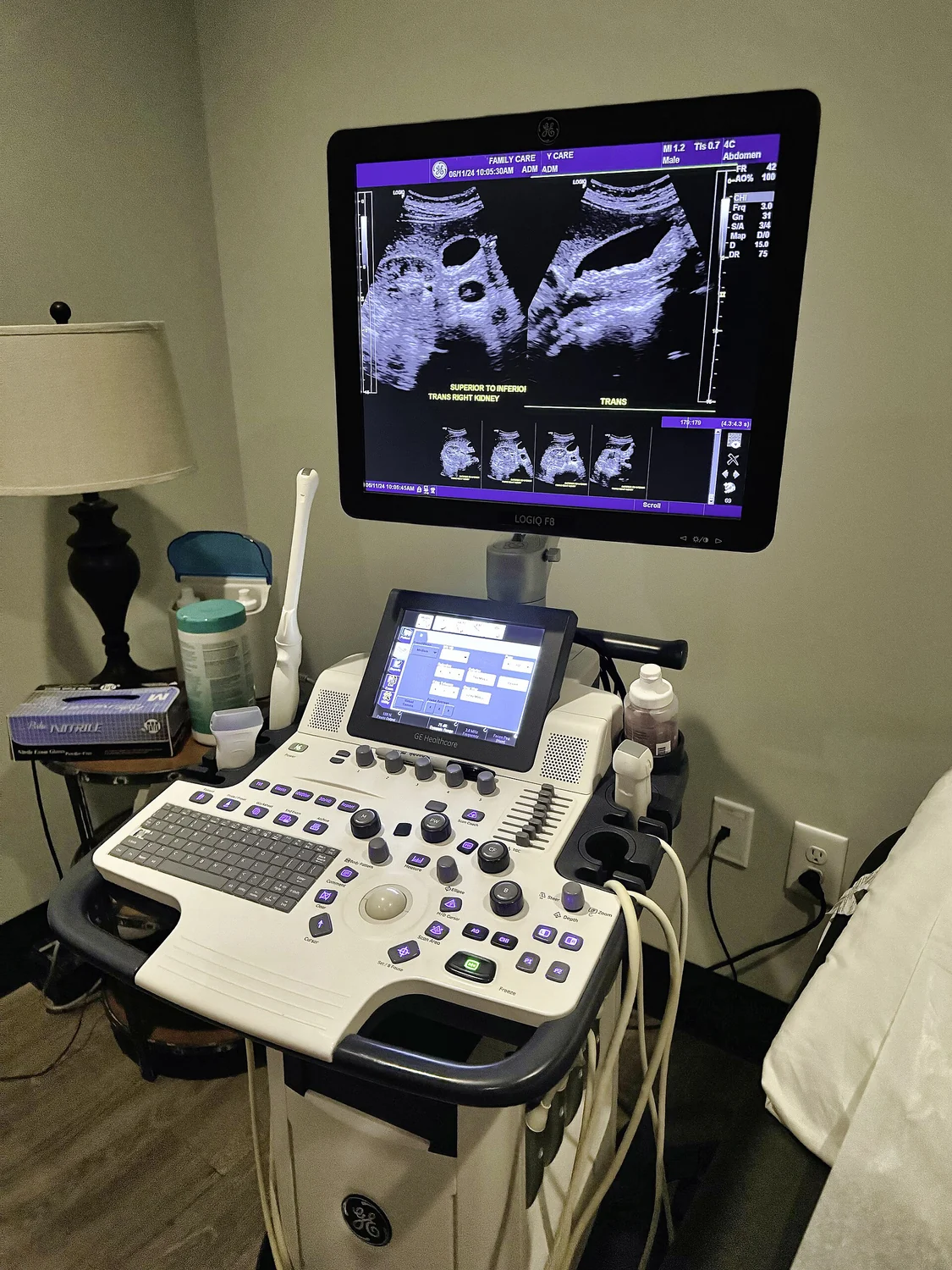
Amplitude describes the size of the pressure variation and is related to perceived loudness, though hearing is not a simple meter. A quiet sound still needs a medium, and a powerful sound cannot cross a vacuum. These distinctions matter in medicine: diagnostic ultrasound sends high-frequency pulses into the body, then listens for echoes at boundaries between tissues. The transducer both emits the waves and detects the returning ones [2].
From air vibration to a nerve signal
Hearing is a conversion chain. Sound waves enter the ear canal and vibrate the eardrum. Three small middle-ear bones transmit and amplify the motion toward the cochlea, a fluid-filled structure in the inner ear. There, vibration creates a traveling wave along the basilar membrane. Different locations respond best to different frequencies, helping the ear distinguish pitches [1].
Hair cells ride that wave. Their tiny projections bend against an overlying structure, opening channels that allow chemicals to enter the cells and generate electrical signals. The auditory nerve carries those signals to the brain, which interprets them as sound. At each step, the form of the signal changes—from pressure fluctuations in air, to mechanical motion, to fluid waves, to electrical activity—but the original disturbance depended on a medium all the way to the eardrum [1].
Ultrasound turns echoes into a map
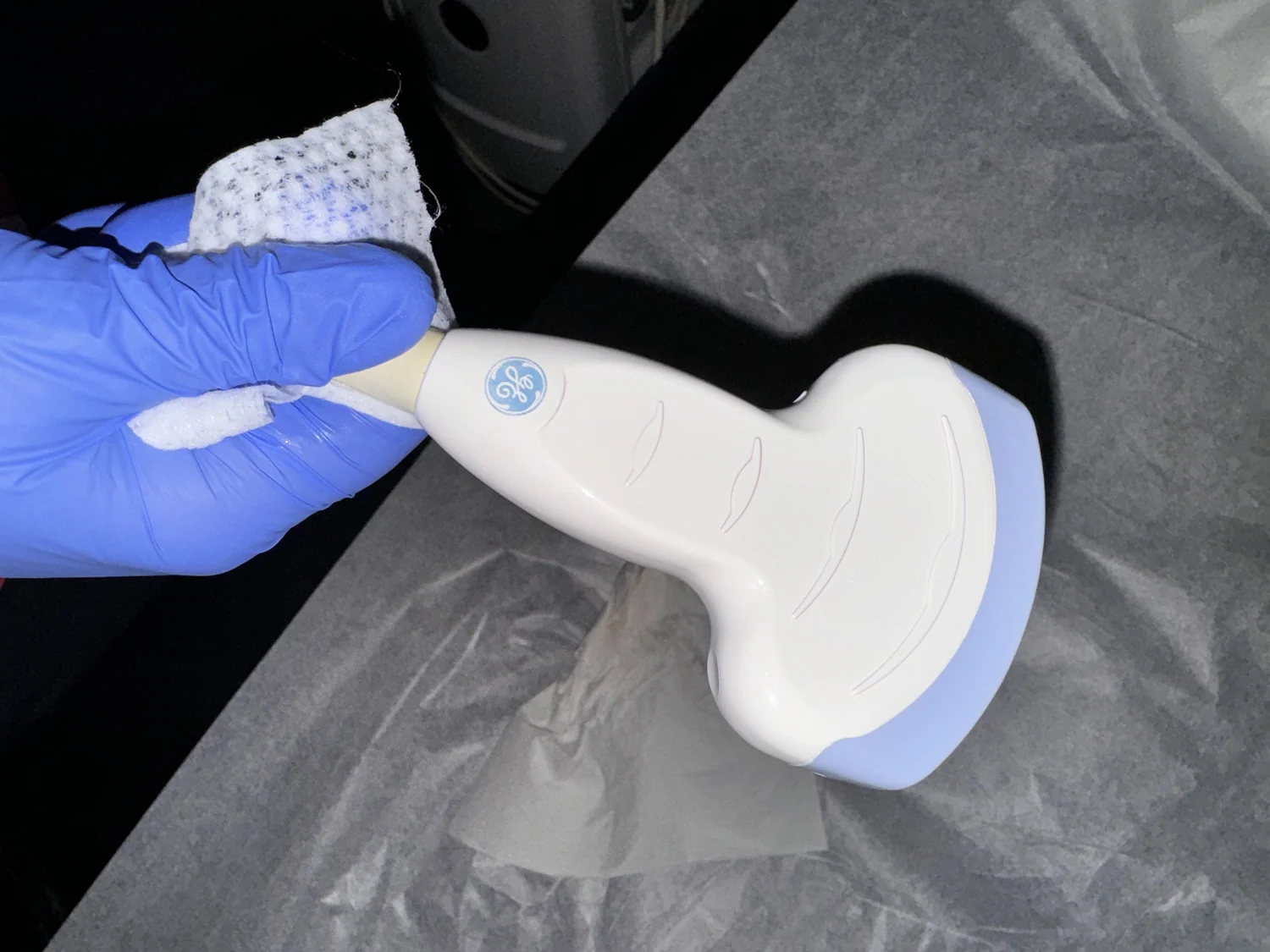
An ultrasound probe sends a pulse into the body. When the sound meets a boundary, such as one between fluid and soft tissue, part of it reflects. The probe detects the echo, and the scanner uses the time it took to return and the speed of sound in tissue to estimate the boundary’s depth. Many such measurements can be assembled into a two-dimensional image [2].
The need for a medium also explains a practical detail: air pockets between probe and skin can block sound from entering the body, so gel helps maintain acoustic contact. Ultrasound is useful for many soft tissues but does not image bone or air-containing tissues well under ordinary conditions. Diagnostic ultrasound is generally regarded as safe and does not use ionizing X-rays, though it can produce biological effects under specific settings and is used for medical reasons rather than casually [2]. The same principle that makes a vacuum silent thus shapes both the hearing process and the design of an imaging exam.
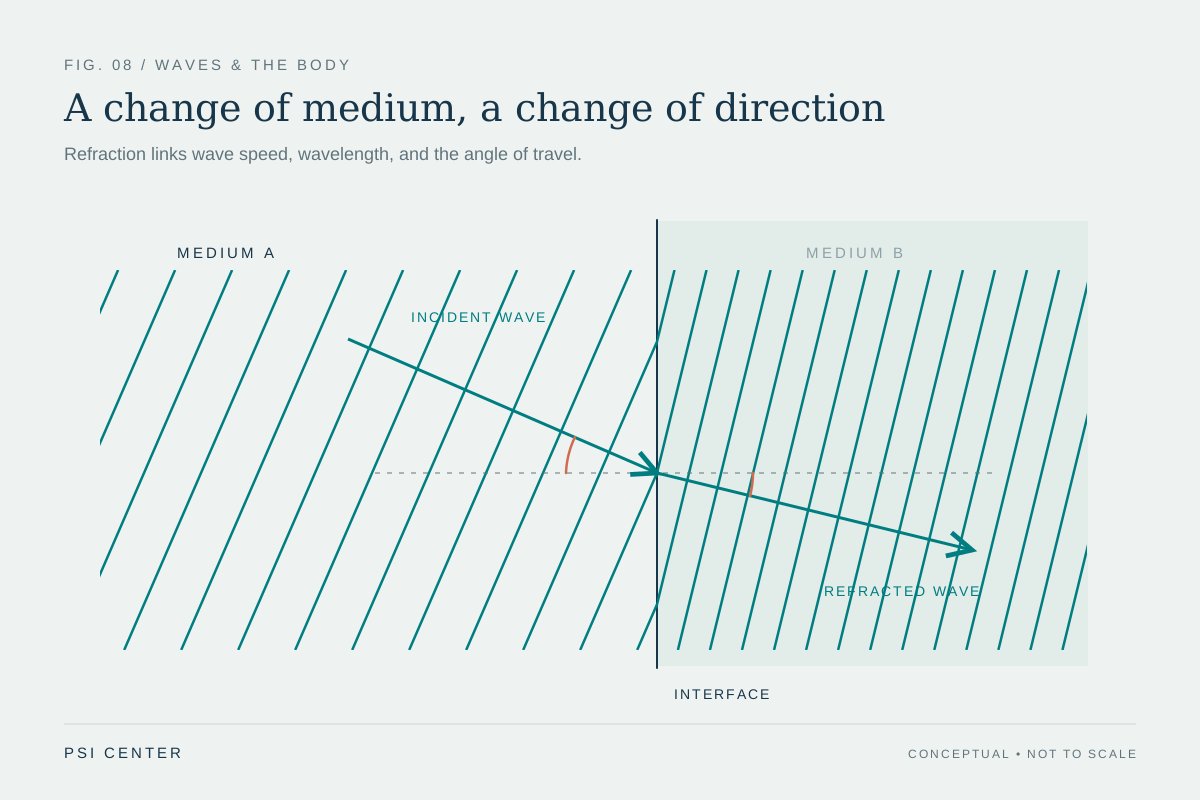
Explore the physics: an explanatory diagram
Sources & further reading
- How Do We Hear? NIDCD
- Ultrasound NIBIB
Prepared for the independent PSI Center reading library. About edition dates and source checking.
This explainer describes scientific principles. It does not assess individual treatment choices.