Why does a drop of blood behave differently inside a tiny diagnostic channel than in a large container? The answer is not that the underlying physics changes. Rather, shrinking a system changes which physical effects matter most. Distances get shorter, surfaces become more influential relative to volume, and small disturbances can have large consequences for what a device measures.
Surface becomes a bigger part of the system
Imagine cutting a block into many smaller blocks without changing the total amount of material. The total surface area grows as the pieces shrink. In a miniature medical device, this means a larger fraction of the sample is near a wall, coating, or sensing surface. Molecules can encounter that boundary frequently, so surface chemistry may strongly affect whether they stick, pass through, or trigger a sensor.
That matters in diagnostics because a test relies on a sample meeting a recognition element and producing a readable signal. Rapid tests are designed around accessible samples and portable formats, but their results still depend on the test’s ability to identify the target correctly [1]. Miniaturization can make a device convenient; it does not automatically make its measurement accurate.
Short paths can help—and complicate
When distances shrink, diffusion—the random motion that spreads molecules—can move a target across a device more quickly. A small sample may therefore reach a sensing region without the pumping and plumbing required by a larger system. But the same short paths mean that a molecule lost to a wall or a bubble disrupting flow can account for a larger share of the sample.
Consider trying to detect a scarce target in a tiny drop. If only a few target molecules are present, their arrival at the sensor may vary by chance. A device must be designed around that variability, alongside the chemistry of capture and the noise of the readout. A compact assay can offer speed and convenience, but its performance needs to be established for its actual sample and use.
Materials shape the boundary
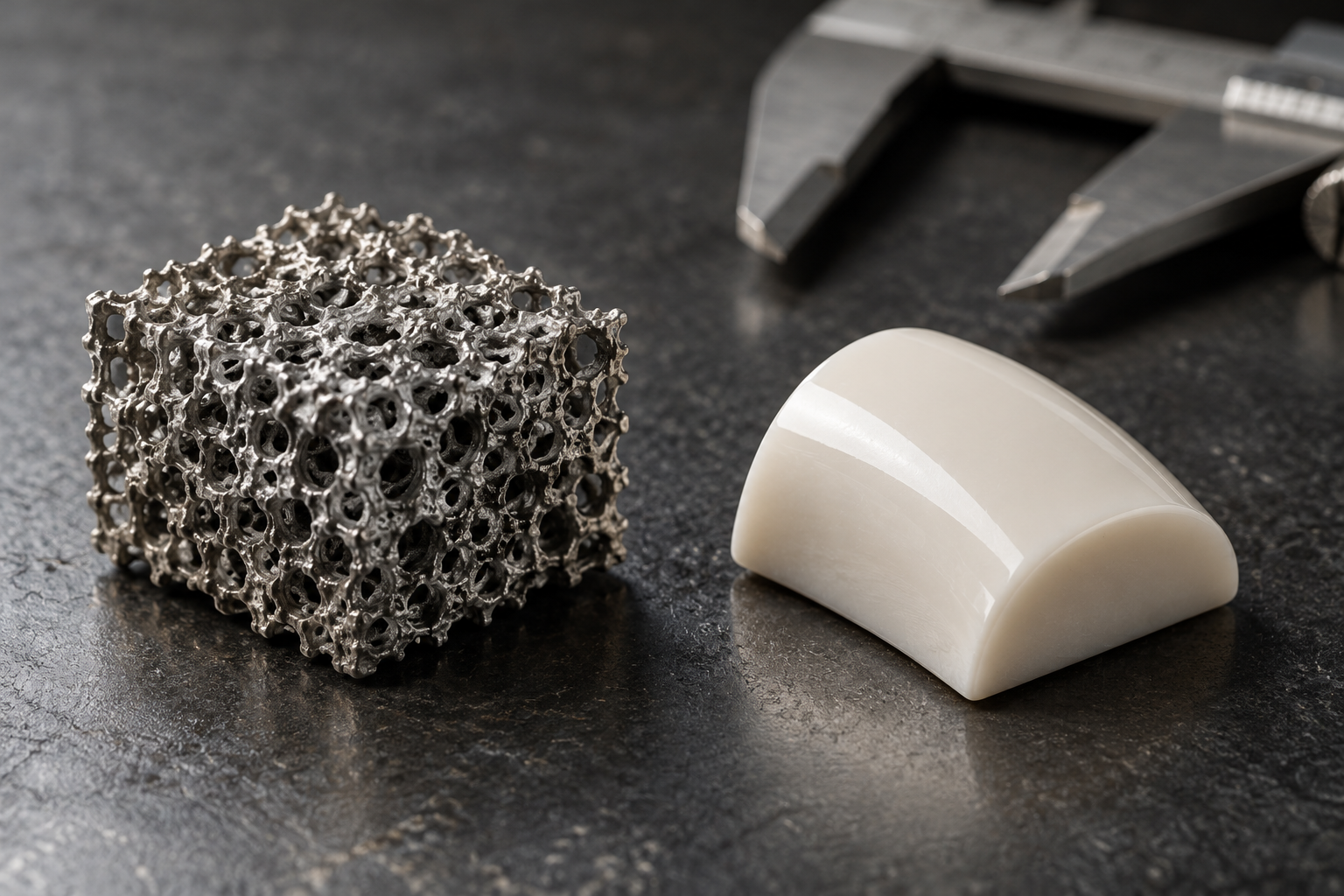
In small devices, the material surface is part of the measurement environment. Biomaterials can be formed into films, fibers, coatings, and other structures, and their stiffness or chemical composition can be selected for particular interactions with tissue or fluids [2]. A coating may encourage compatibility or hold a therapeutic for controlled release. The material is not merely a passive container; it can alter what happens at the boundary.
This is one reason a material that works well in a large implant may not behave identically when fashioned as a thin film or tiny particle. Geometry changes the balance between surface and interior, while the local surroundings determine what the material encounters. A drug carrier, for example, has to protect its payload while circulating and then permit release under the intended conditions [2].
Small does not mean simple
Compact point-of-care tests demonstrate a real advantage of small systems: results can be available quickly, often at a clinic, home, or other location near care [1]. Yet a test’s utility also depends on sensitivity and specificity, the ability to recognize people with and without the condition [1]. A fast, portable result is only useful if it answers the relevant question with adequate reliability.
The physics of scale therefore offers both opportunity and constraint. Short distances can speed transport; abundant interfaces can enable sensing and release; and small sample volumes can simplify a test. Those same features can magnify losses, variability, and surface effects. The right design begins by asking which effect dominates in the particular device, then measuring whether its output remains dependable under the conditions in which it will be used.
Sources & further reading
- Rapid Diagnostics NIBIB
- Biomaterial Technologies NIBIB
Prepared for the independent PSI Center reading library. About edition dates and source checking.
This explainer describes scientific principles. It does not assess individual treatment choices.