Why does a dialysis filter contain so many tiny hollow fibers instead of one wide tube? The answer is partly geometry. A large combined surface gives blood and dialysis solution many places to exchange substances across a thin barrier. Surface area is the amount of exposed boundary between materials, and device designers use it to increase or control interaction. The same idea appears in implants, coatings, and lenses, though each application asks the surface to do something different.
Many small boundaries add up
Picture a single tube with a fixed volume, then imagine splitting that volume into many thin fibers. The outside boundary grows as the fibers become narrower and more numerous. More surface can create more opportunity for exchange, provided the relevant substances can reach it and cross the barrier. Geometry sets a potential interaction area, not a guaranteed result.
A dialyzer uses this arrangement. Blood flows inside many thin hollow fibers while dialysis solution flows in the opposite direction outside them. Wastes move from blood into the solution, while filtered blood remains inside the fibers and returns to the body [1]. The surface between blood and the surrounding solution enables this exchange, and the opposing flows maintain contact along the filter.
Area works together with flow
More surface alone cannot do the whole job. If fluid does not reach a region, or if its motion is poorly arranged, some area contributes little. NIDDK describes the dialysis machine as controlling how quickly blood flows through the filter and how rapidly fluid is removed [1]. The dialyzer’s fibers and the operating flow are therefore parts of one design.
A useful analogy is washing gravel: adding more stone surface helps only if water can pass around the pieces. Crowding can block contact. This principle also appears in instrument reprocessing. The CDC advises avoiding stacked instruments in washers and opening hinged instruments so detergent solution can contact them [2]. Surface area is useful when the surrounding fluid can access it; device layout and fluid movement determine whether that access occurs.
An implant surface meets living tissue
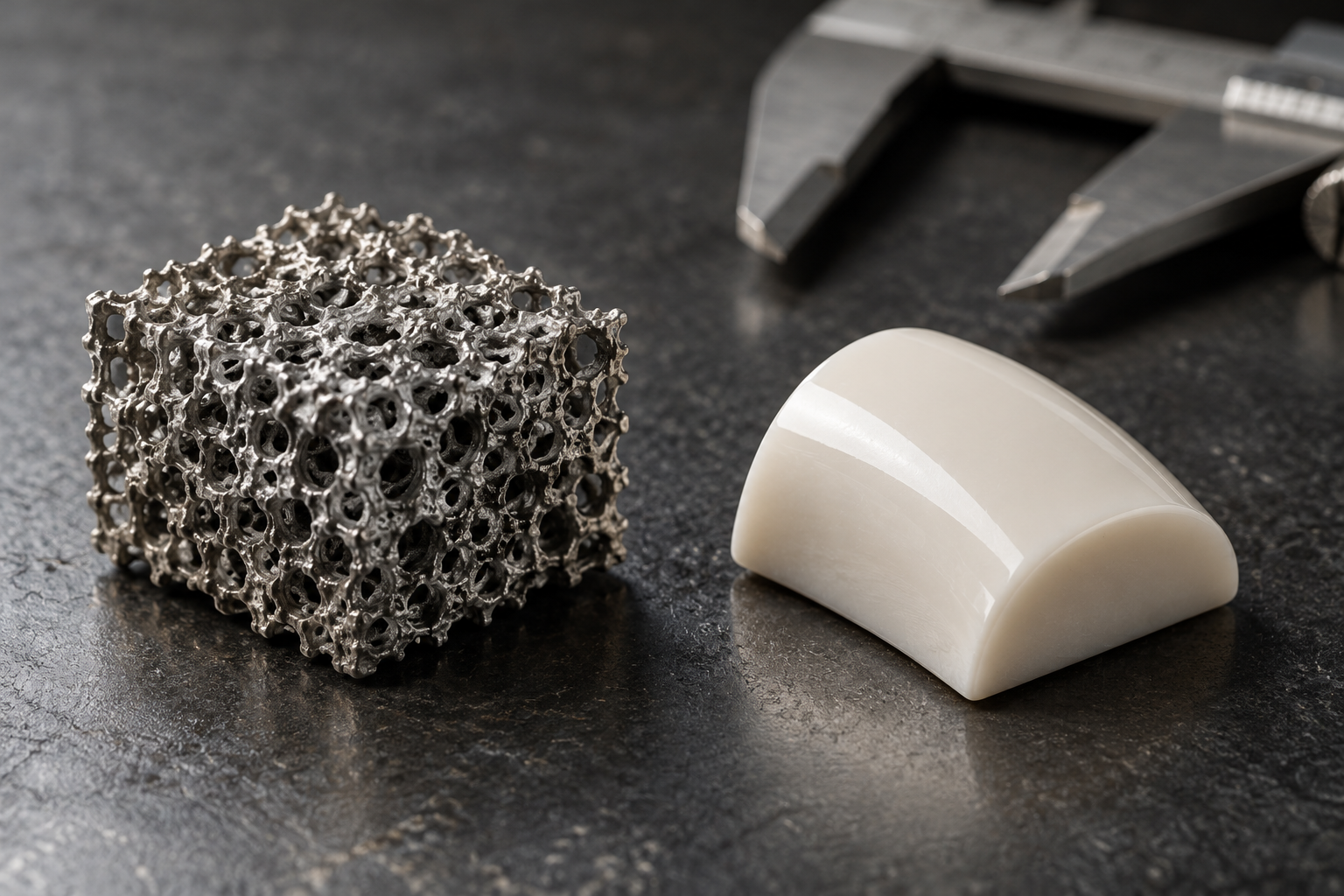
For an implant, surface area is not only about exchange. It is also where the body encounters the device. The immune system can react to foreign objects, sometimes surrounding them with scar tissue in a process called the foreign body response [2]. That response may interfere with device function. Surface chemistry, texture, and structure can influence how tissue interacts with the implant.
Some materials aim to resemble parts of the body’s extracellular matrix, the natural scaffold that surrounds cells. NIBIB describes hydroxyapatite coatings on orthopedic implants as encouraging tissue ingrowth and supporting device longevity [2]. Here, the surface is designed to promote integration rather than simply maximize exchange. A material that performs well as a filter membrane may not be suitable as an implant coating: the physical task and biological interface differ.
Device geometry follows its purpose
A lens shows another role for material design. Contact and intraocular lenses must transmit light and bend it at an appropriate angle to help restore vision [2]. The relevant interaction is optical, not the movement of molecules across a membrane. Transparency, curvature, and refractive behavior matter more than maximizing exposed area.
A medical device’s shape therefore expresses a physical goal. Dialysis fibers create extensive contact for exchange; implant coatings shape tissue response; lenses guide light. Even within one device, area must be balanced with access, strength, flexibility, and compatibility. NIDDK notes that dialysis can replace part, but not all, of kidney function [1]. That reminder points to a broader design truth: geometry can make a specific interaction possible, but it does not make a device equivalent to the organ or tissue it supports.
Sources & further reading
- Hemodialysis NIDDK
- Biomaterial Technologies NIBIB
Prepared for the independent PSI Center reading library. About edition dates and source checking.
This explainer describes scientific principles. It does not assess individual treatment choices.