If both sound and radio waves can travel through the body, what exactly is moving in each case? Sound is a mechanical disturbance passed from particle to particle through a material. An electromagnetic wave is a changing electric and magnetic field that can travel without matter. The difference explains why ultrasound needs tissue to carry its pulses, while radio waves and visible light belong to a separate physical family.
Sound passes through matter
Sound begins when something vibrates. In air, the vibration creates regions where molecules are crowded together and farther apart; those pressure changes travel outward. In liquids and solids, particles also pass the disturbance along. The particles oscillate around their positions while the wave carries energy forward. Sound therefore needs a material medium—gas, liquid, or solid—to propagate.
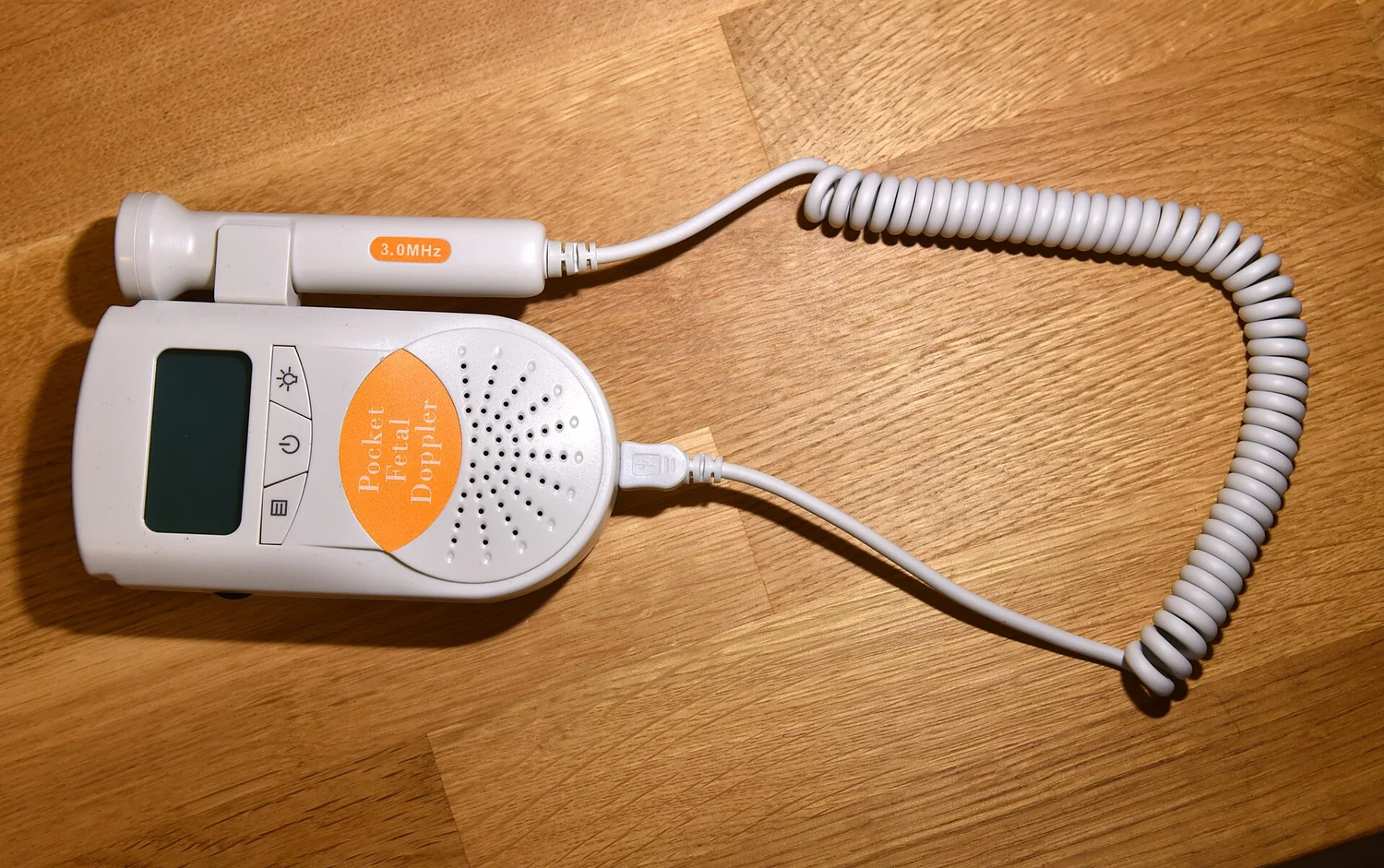
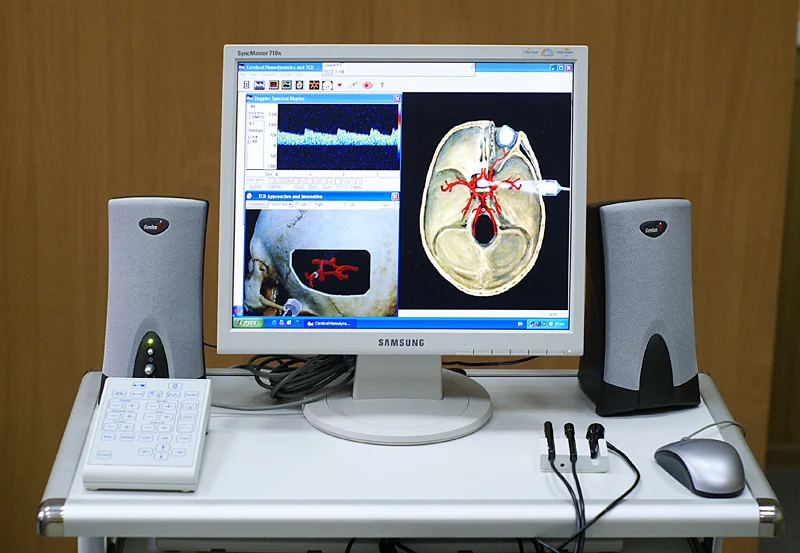
Medical ultrasound uses frequencies above the range of human hearing, commonly in the megahertz range. A probe sends sound into the body and detects echoes returned from boundaries between tissues. The time delay helps estimate the boundary’s depth, and the strength and pattern of echoes contribute to an image [1]. The method depends on mechanical waves moving through tissue and reflecting at changes in acoustic properties.
Fields can travel without particles
Electromagnetic waves are disturbances in electric and magnetic fields. Unlike sound, they do not require air or tissue as a medium; light from the Sun crosses the vacuum of space before reaching Earth. Radio waves, infrared, visible light, x-rays, and gamma rays all belong to the electromagnetic spectrum, with different frequencies and wavelengths. Visible light is only a narrow portion of that range [2].
The word “radiation” can refer to energy carried by waves, but it does not mean all waves have the same effects. Higher-frequency electromagnetic radiation such as x-rays and gamma rays is ionizing: it can damage DNA or cells directly. Radio waves, infrared, and visible light are non-ionizing and are not known to damage DNA directly in that way [2]. This distinction concerns electromagnetic energy; it does not turn sound into a kind of radiation in the same sense.
An echo and a radio signal
A useful comparison is to imagine tapping a wall and shining a radio transmitter toward it. The tap launches a mechanical disturbance through the wall; an echo or vibration depends on how the material responds. The radio transmitter launches electromagnetic energy, whose fields can propagate through space and interact with matter in other ways. Both can return information about their surroundings, but their physical carriers differ.
Ultrasound systems use a transducer that can both emit sound and detect echoes. In many probes, piezoelectric crystals convert electrical energy into mechanical vibration and convert returning pressure waves back into electrical signals [1]. An MRI system, by contrast, uses strong magnetic fields and radiofrequency signals to obtain information from the body; it does not use plasma or ionizing x-rays. Radiofrequency waves are one part of the electromagnetic spectrum, distinct from the mechanical sound pulses used by ultrasound [2].
Why the distinction matters in medicine
The physical difference helps explain why each method has different strengths and limits. Ultrasound is hindered by air and bone because the sound beam needs to travel through material and can be reflected or absorbed along the way. Optical methods use light interactions such as absorption and scattering, while MRI relies on magnetic fields and radio waves. Each technique measures a different response, so a shared ability to produce images does not make their mechanisms interchangeable.
Safety language also depends on the wave type and exposure. Diagnostic ultrasound is generally regarded as safe but can produce biological effects under specific conditions, so devices are subject to operating limits [1]. Non-ionizing electromagnetic fields are not known to damage DNA directly, unlike ionizing x-rays and gamma rays, though questions about exposure are evaluated through evidence rather than inferred from the word “radiation” alone [2]. Distinguishing a vibrating medium from changing fields gives readers a more precise way to understand what a device sends into the body and what kind of signal it receives back.
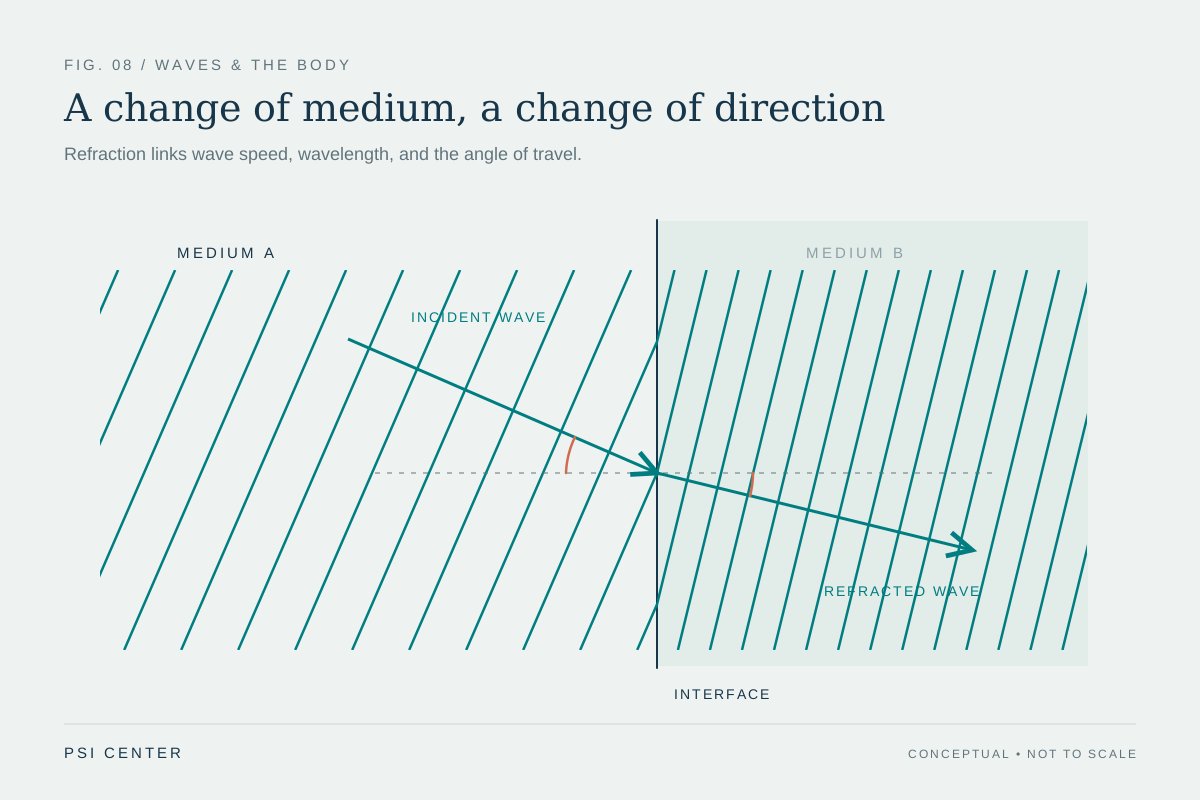
Explore the physics: an explanatory diagram
Sources & further reading
- Ultrasound NIBIB
- Electromagnetic Fields and Cancer National Cancer Institute
Prepared for the independent PSI Center reading library. About edition dates and source checking.
This explainer describes scientific principles. It does not assess individual treatment choices.