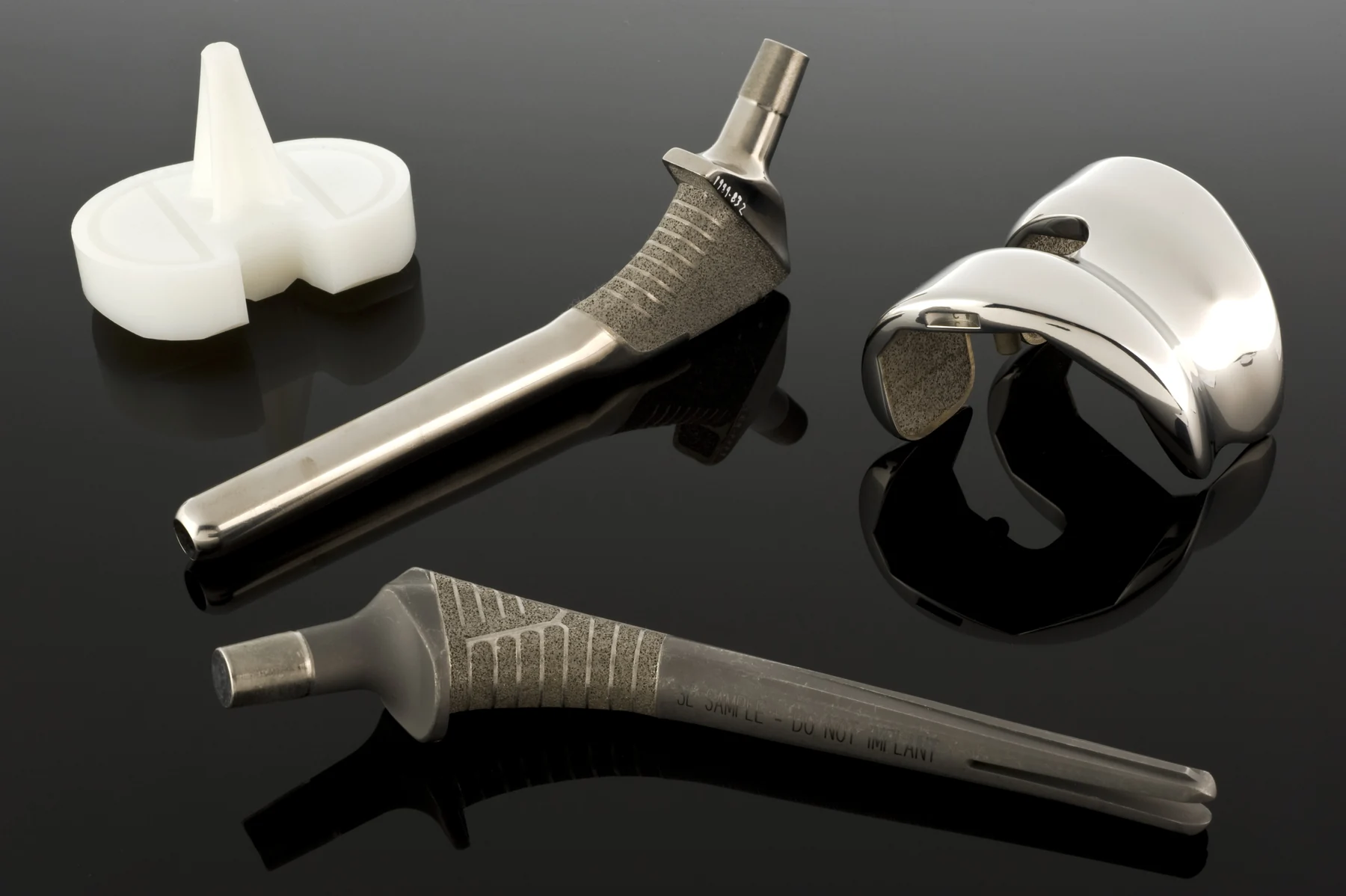
Why should an implant be tested for millions of ordinary movements when it may already withstand a large force once? Because the body loads devices repeatedly. A joint replacement, for example, experiences changing forces as a person stands, walks and sits. Each cycle can stress a material, and tiny changes may accumulate. Long-term performance therefore depends on more than initial strength: design, location, wear, corrosion and the body’s response all matter.
One load is not a lifetime
A material can tolerate a single force and still be vulnerable to repeated loading. Under cyclic loading—forces applied and removed again and again—small cracks may begin and grow. This process is called fatigue. A paper clip illustrates the idea: it can bend once without breaking, yet repeated bending at the same spot eventually weakens it. Implants face a much more complex version because their loads vary with movement and anatomy.
The relevant forces depend on the device’s job and location. A component supporting a joint experiences different directions and patterns of force from one placed in a blood vessel. Repeated loading can interact with material shape, surface finish and the way the device transfers force to surrounding tissue. Engineering models can simulate systems under varied conditions and help researchers study complex behavior [2]. Such models can guide questions, but their predictions depend on the assumptions and data used to build them.
The body is also a chemical environment
A material inside the body is exposed to fluids, cells and local chemical conditions. Metals may wear or corrode, and released particles or substances can prompt biological responses. The FDA evaluates device materials in light of their properties, intended use and function, and manufacturers assess possible biological responses in the context of how and where the device will contact the body [1]. This is why the label “biocompatible” is not a universal guarantee that every material suits every device and location.
The body’s response can vary, and the FDA notes gaps in understanding how people respond to implanted metal devices and what factors shape those responses [1]. Testing may therefore consider more than whether a material irritates cells in one laboratory setup. The full device, manufacturing process, exposure duration and anatomical site all help define the safety question. A material that works well in one setting cannot be assumed to behave identically in another.
Wear and mechanics meet
Repeated movement can cause surfaces to rub, producing wear debris; mechanical stress and corrosion can also interact. The FDA identifies wear and corrosion testing as one way manufacturers may model how a particular device behaves in its intended environment [1]. The chemistry of the surrounding fluid, the geometry of contacting surfaces and the loading pattern influence what can be released and how the device changes.
Consider two surfaces that slide past each other under load. Even if each surface is strong on its own, contact can gradually remove material or alter the interface. In a device, that change may affect fit, function or the biological environment. Computational modeling can explore many combinations of variables in a virtual setting and help identify promising experiments [2]. It does not replace physical testing or clinical evidence: a simulation is a structured prediction, not a direct observation of every possible long-term outcome.
Testing follows intended use
An implant’s intended function sets the questions engineers and regulators must answer. What forces will it face? Where will it sit? How long will contact last? Could movement produce wear, or could corrosion change the material? The FDA describes a risk-based evaluation of biocompatibility that considers the device, its components, manufacturing, clinical use, anatomical location and exposure duration [1]. That broader view connects mechanical reliability to biological safety.
A credible assessment therefore combines different kinds of evidence: material characterization, engineering tests, biological evaluation and, where appropriate, modeling. Each addresses a different uncertainty. A strong component is not automatically safe in every body location, and a favorable cell test does not prove long-term clinical performance. Repeated loading matters because an implant is not a static object; it is part of a moving, living system. Its design has to account for both the forces it carries and the environment it shares with the body.
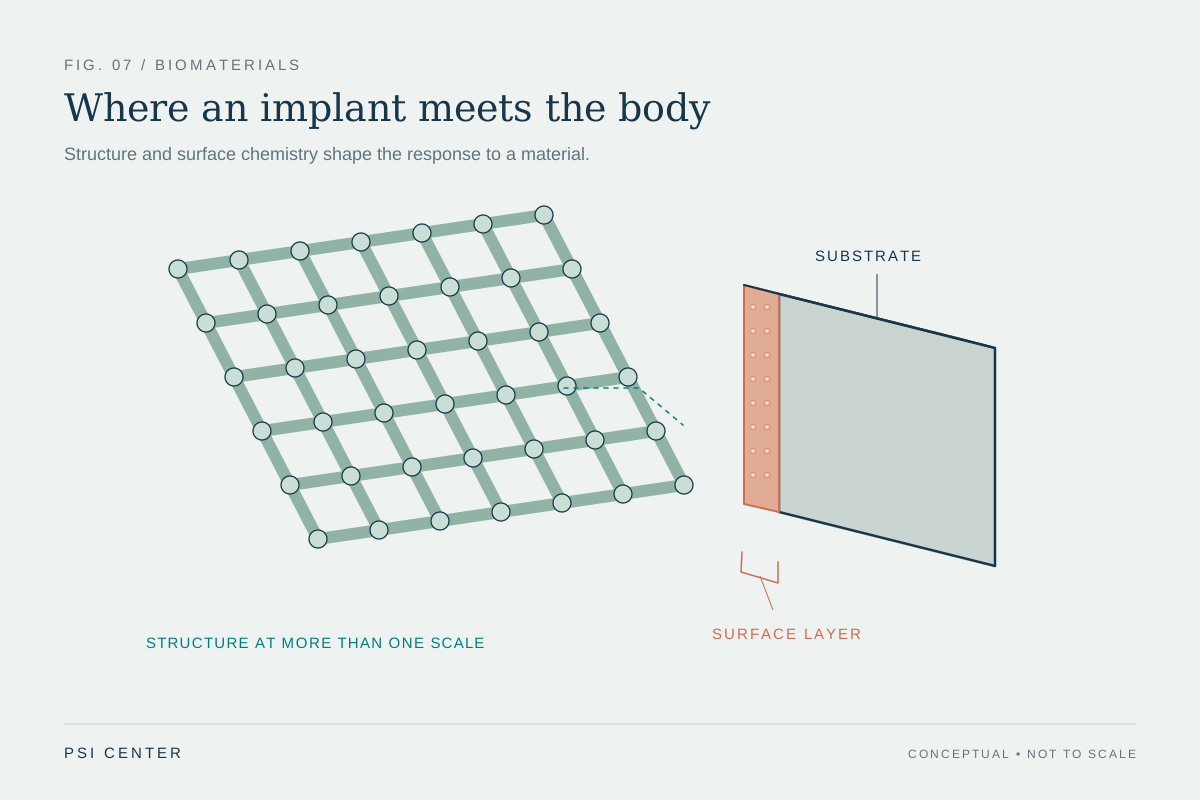
Explore the physics: an explanatory diagram
Sources & further reading
Prepared for the independent PSI Center reading library. About edition dates and source checking.
This explainer describes scientific principles. It does not assess individual treatment choices.