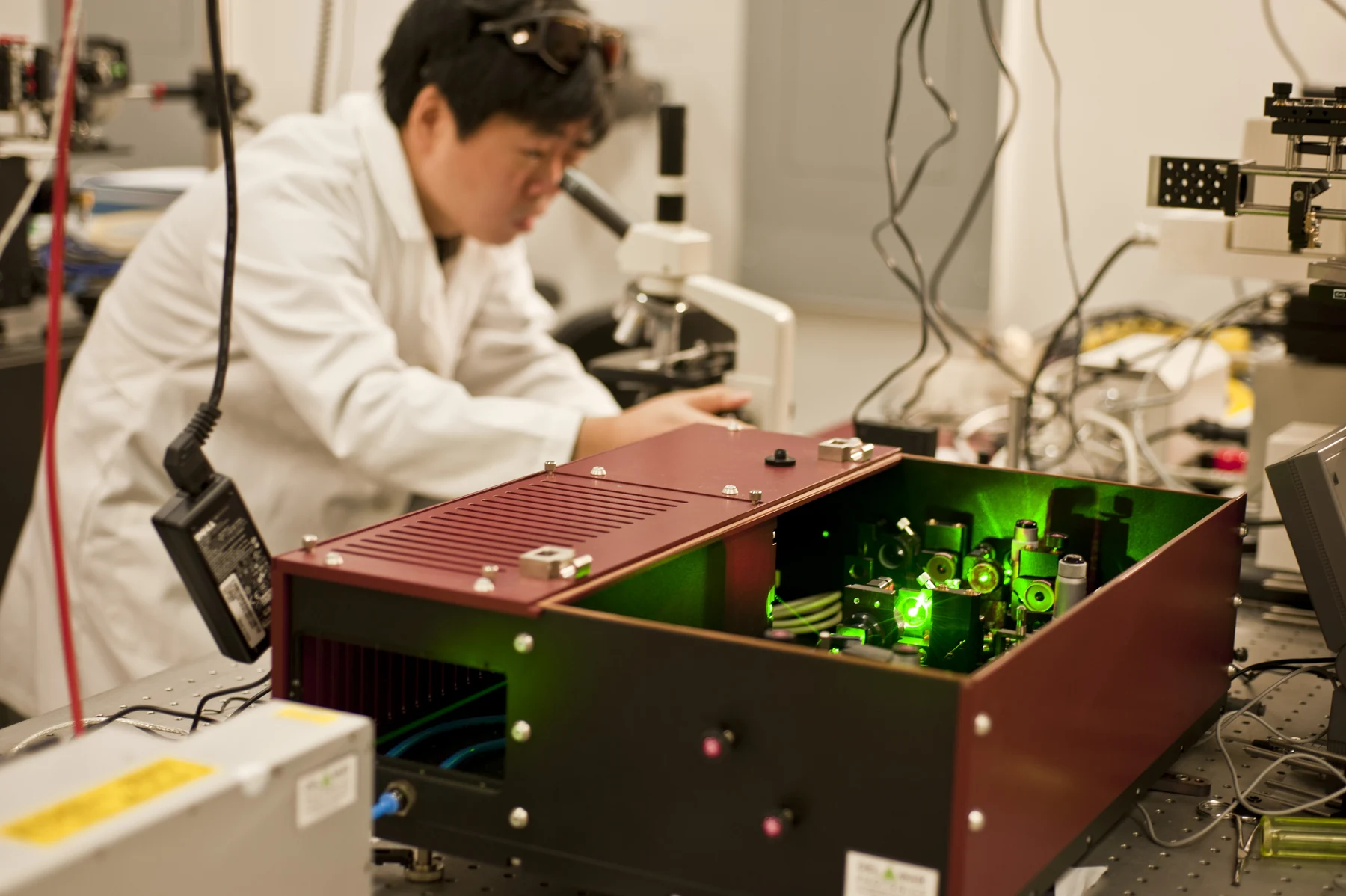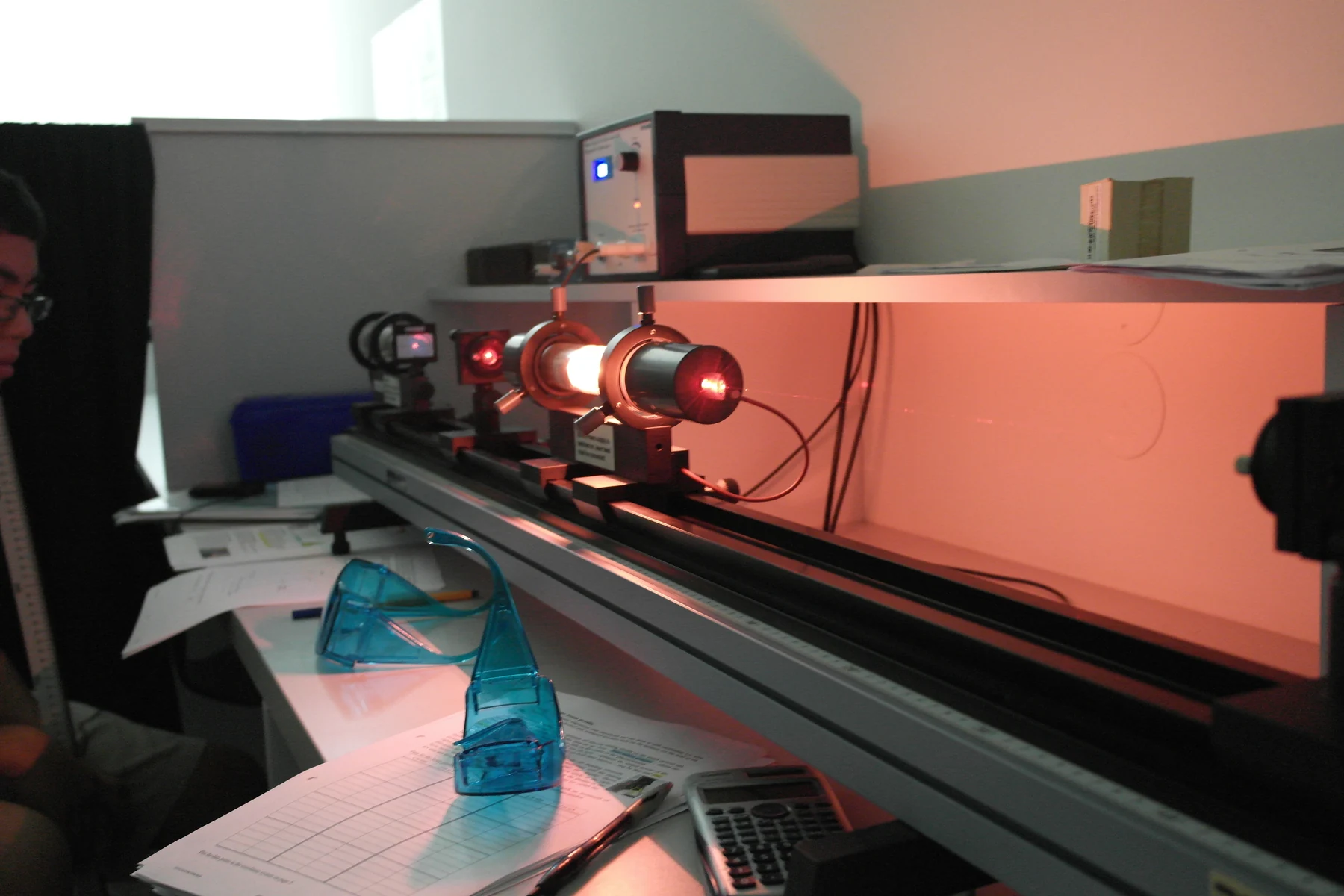
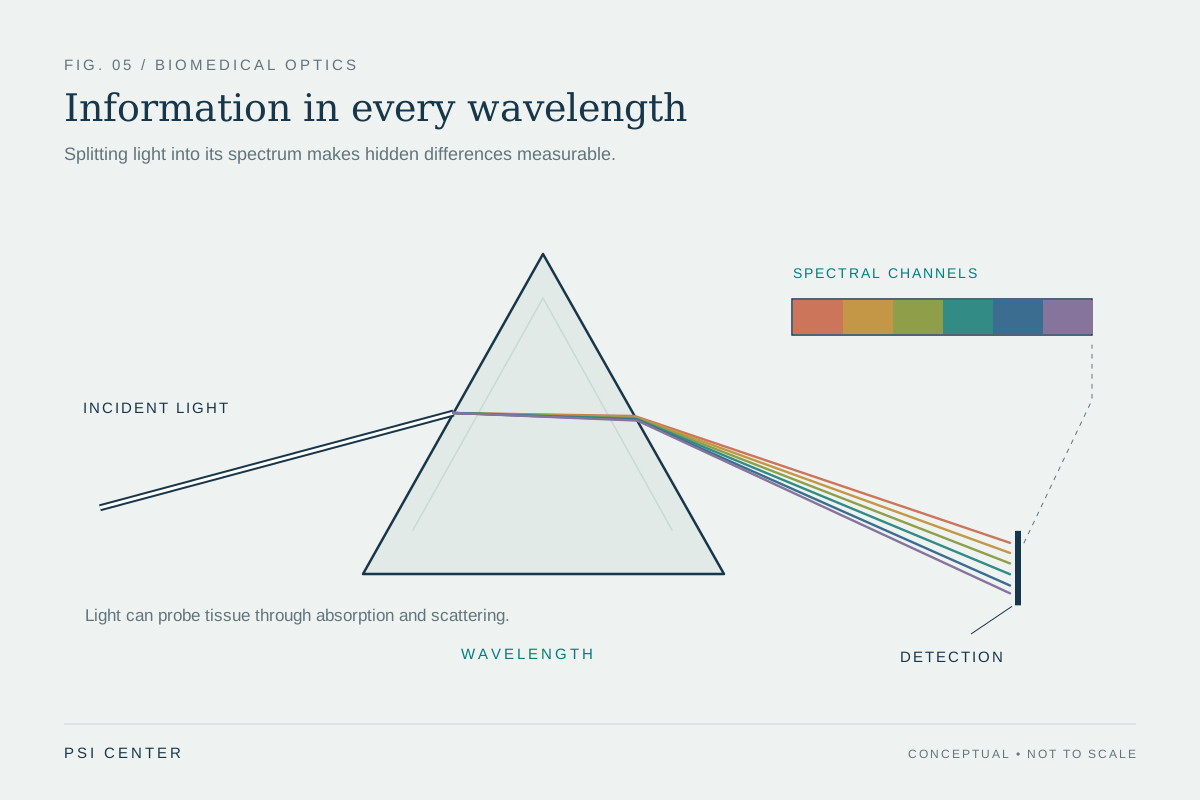
Why can one beam of light show layers beneath the skin while another is used to cut tissue? The answer begins with wavelength: the distance between repeating peaks of a light wave. Wavelength affects how light interacts with molecules and structures in the body. It helps determine whether a beam is absorbed, scattered, reflected, or transmitted—and, in a medical setting, which signals can be seen or which tissue can be reached.
Light meets tissue in several ways
When light enters tissue, it does not simply travel in a straight line. Molecules may absorb its energy; small structures can scatter it in new directions; boundaries can reflect some of it. Some materials also emit light after absorbing it. These interactions make optical imaging possible: instruments detect how light has changed and use that information to reveal biological structures or processes. [1]
A useful mental experiment is to shine two colors through a cloudy glass. One may emerge more strongly than the other, while both spread as they pass through. Tissue is more complex than glass, but the principle holds: its components absorb and scatter different wavelengths by different amounts. The wavelength selected therefore influences both the depth reached and the contrast available.
The wavelength sets the kind of view
Visible light works well for microscopy of thin samples and surfaces, where lenses can magnify cells and tissue. For subsurface views, optical coherence tomography (OCT) uses infrared light to create cross-sectional images, including detailed views of the retina. Its echoes are not sound waves, as in ultrasound; the instrument analyzes light returned from tissue layers. [1]
Near-infrared light is useful in diffuse optical imaging because it can probe soft tissue and help estimate properties such as hemoglobin concentration and blood oxygen saturation. Photoacoustic imaging takes a different route: laser pulses are absorbed by tissue, producing ultrasound waves that a detector can measure. Combining optical absorption with sound detection can yield high-resolution views deeper in tissue than ordinary light imaging alone. [1]
A treatment beam has a different job
In laser treatment, choosing a wavelength can help direct energy toward a target. The National Cancer Institute describes laser therapy as a local treatment: an intense, narrow beam can remove or destroy cancer or abnormal cells. In some situations, the selected wavelength is chosen because tumor cells absorb it differently from nearby normal cells. The clinical effect still depends on how the beam is delivered and on the tissue involved. [2]
Other laser procedures use light to heat tissue. Laser interstitial thermal therapy, for example, is a form of local hyperthermia in which laser light is carried through optical fibers to a treatment site. This is a thermal effect: absorbed light becomes heat. It differs from imaging, where the goal is to interpret returned light, and from photodynamic therapy, which uses light as part of a treatment involving a light-sensitive substance. [2]
One color cannot do every task
A wavelength that reaches a useful depth may provide less detail about a particular molecule; one strongly absorbed by a target may deposit energy close to the surface. That is why medical optics involves trade-offs among depth, contrast, resolution, and heating. It also explains why a single device may combine more than one imaging method: optical signals can be paired with MRI or other techniques to provide complementary information. [1]
The choice is therefore not a simple ranking of colors from best to worst. It is a match between a physical interaction and a practical question: Which tissue feature should be measured? How far below the surface is it? Is the aim to observe or to deliver energy? Those questions turn wavelength from a label on a laser into a design decision that shapes what medicine can see and do.
Explore the physics: an explanatory diagram
Sources & further reading
- Optical Imaging NIBIB
- Lasers in Cancer Treatment National Cancer Institute
Prepared for the independent PSI Center reading library. About edition dates and source checking.
This explainer describes scientific principles. It does not assess individual treatment choices.