Why place a radiation source inside the body when radiation can be aimed from outside? Brachytherapy brings a source close to a tumor, sometimes within it. That short distance changes how radiation spreads through nearby tissue. The method is a form of internal radiation therapy, and its geometry—where the source sits relative to the target and surrounding structures—is central to how the treatment is planned and delivered.
Nearness changes the pattern
Radiation spreads outward from a source. For a compact source in open space, the intensity generally falls rapidly with distance because the same output is distributed over a larger area as it travels outward. Tissue also absorbs and scatters radiation, adding further changes along the path. This makes distance a powerful feature of local radiation treatment: tissue near the source can receive more radiation than tissue farther away.
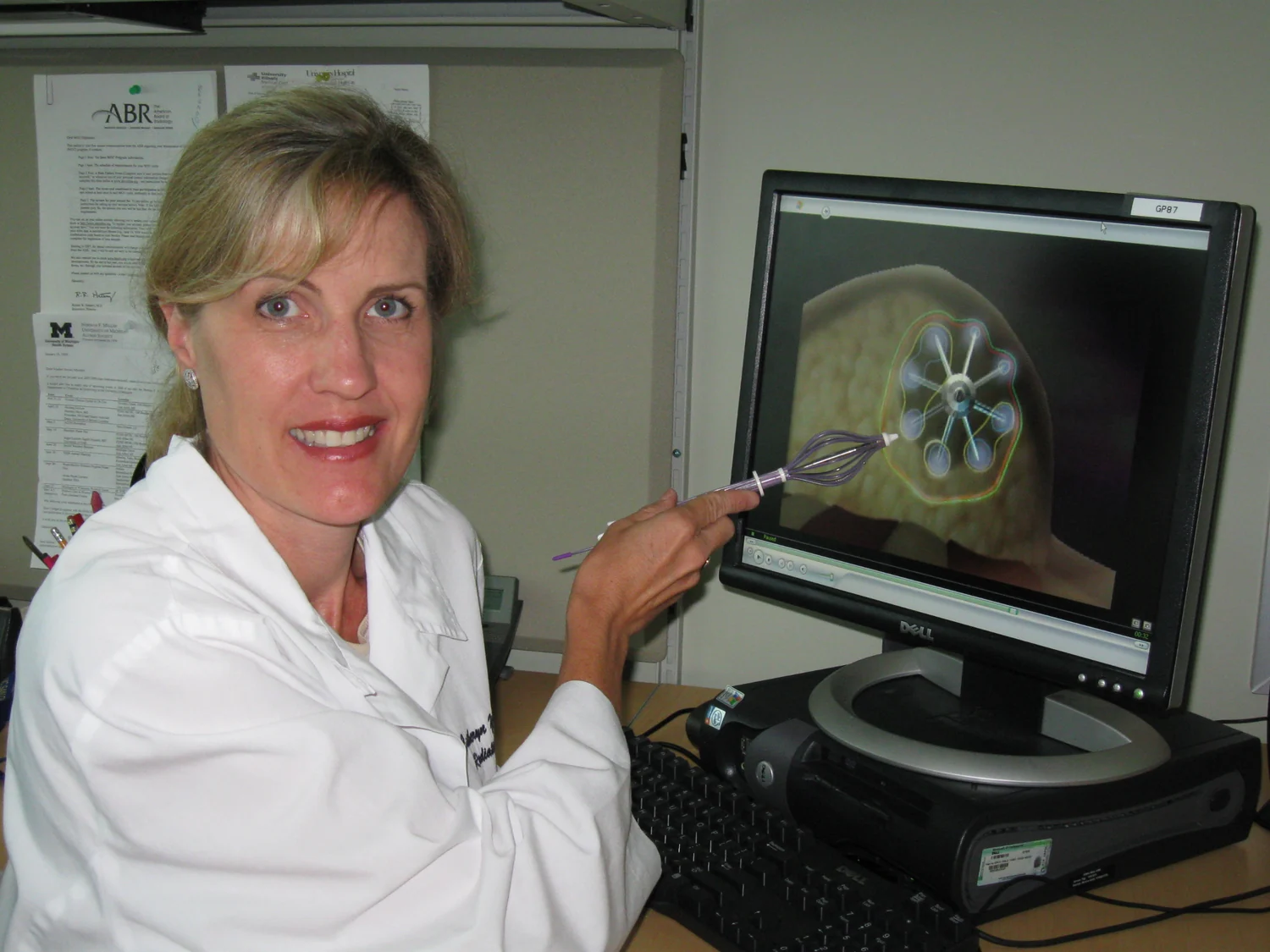
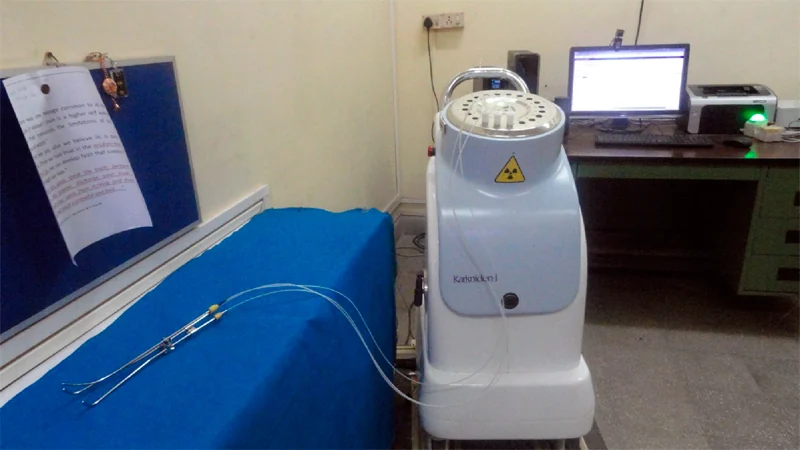
Brachytherapy uses seeds, ribbons, or capsules containing a radiation source placed in or near a tumor [1]. The source may be positioned within the tumor (interstitial treatment) or in a nearby body cavity (intracavity treatment). These arrangements put the source close to the intended target, rather than relying only on a beam entering from outside the body.
Placement is a geometry problem
Imagine a small lamp placed close to one side of a wall. The nearby patch is bright, while the light spreads and dims across more distant surfaces. A radiation source behaves differently from visible light in important ways, but the mental experiment illustrates why position matters. Move the source a little, and distances to the tumor and nearby normal tissues change. The radiation pattern changes with them.
In practice, a catheter or applicator can provide a route for placing the source. Depending on the treatment, it may remain in place for minutes, days, or longer; some implants are permanent [1]. The target’s shape and location, the source type, and the placement method all affect the resulting distribution. Planning must account for nearby organs and structures as well as the tumor, because local does not mean isolated from surrounding tissue.
Radiation is energy carried through tissue
Some radiation has enough energy to remove electrons from atoms and molecules. This is called ionizing radiation. X-rays and gamma rays are examples; they can damage DNA, which is one reason radiation can harm healthy cells as well as cancer cells [2]. Treatment aims to use that damage against a tumor while managing effects on normal tissue.
Distance is only one part of this balance. The type and strength of the source, how long it is present, its position, and the tissue along its path all matter. A source that remains temporarily can be removed after a treatment interval, while a permanent implant continues to emit radiation as its activity diminishes over time [1]. These differences influence planning and the practical precautions associated with a particular procedure.
Local treatment still needs careful planning
Brachytherapy can treat a defined region, but nearby healthy structures may also be exposed. Planning therefore involves more than putting a source near a tumor; it requires choosing an arrangement suited to the tumor’s location and intended treatment. The delivery method and duration vary by cancer and source type, so one description cannot represent every brachytherapy plan.
The underlying physical idea is simple: moving a source changes the distance and direction through which radiation travels. The clinical application is complex because anatomy, source characteristics, and treatment goals must be considered together. Keeping that distinction in view avoids two errors—assuming that internal placement makes radiation harmless beyond the tumor, or assuming that all radiation exposure has the same pattern regardless of where its source is placed.
Sources & further reading
- Brachytherapy National Cancer Institute
- Radiation National Cancer Institute
Prepared for the independent PSI Center reading library. About edition dates and source checking.
This explainer describes scientific principles. It does not assess individual treatment choices.