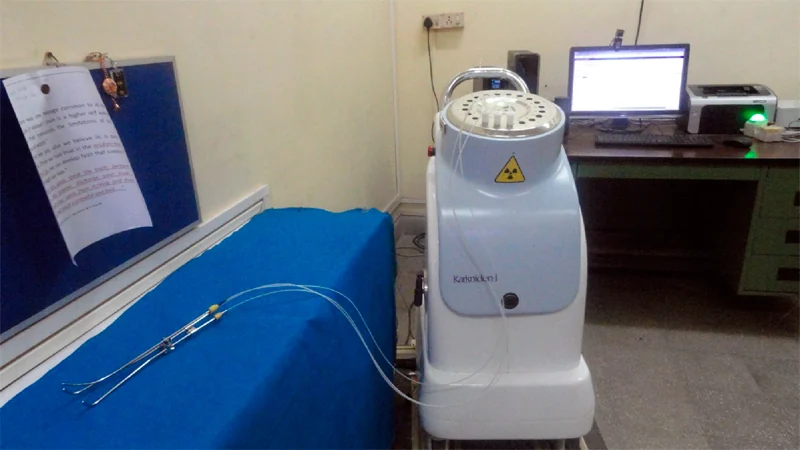
How can a carefully calculated radiation plan still need another check? A plan turns images and clinical goals into machine settings intended to direct radiation toward a tumor while limiting exposure to nearby tissue. Each step depends on measurements and assumptions. Independent checks provide another way to find discrepancies before a calculation becomes a treatment delivery.
From images to a treatment path
External beam radiation therapy uses a machine to aim radiation at a specific part of the body. It is a local treatment, and a computer analyzes images of the tumor to calculate a dose and treatment path [2]. In three-dimensional conformal therapy, images help define the treatment area and beams come from multiple directions. Intensity-modulated radiation therapy varies the strength of smaller beams to shape dose distribution [2].
That plan rests on a chain of inputs: the location and shape identified on images, the intended target, and the machine’s delivery geometry. A change in patient position or tumor location can affect whether the planned path lines up with the anatomy at treatment. Image-guided radiation therapy addresses this by using scans during sessions to detect changes in tumor size or position and allow adjustments when needed [2].
Uncertainty is part of measurement
No measurement is perfectly exact. Metrology—the science of measurement—uses uncertainty to describe the range of values reasonably associated with a result, given the measurement process. NIST provides guidance on evaluating, combining, and expressing uncertainty components [1]. Uncertainty is not a confession that a measurement is useless; it makes clear how much confidence its precision supports.
In treatment planning, uncertainty can arise in image measurements, patient positioning, or how a calculation represents the physical situation. If a target lies near normal tissue, even small differences in inputs may matter to the planned distribution. A plan’s numerical precision should therefore not be mistaken for perfect knowledge. Explicitly considering uncertainty helps teams understand which assumptions deserve attention.
Why an independent check adds value
An independent check asks whether the result can be reproduced or tested through a separate calculation, measurement, or review. The logic is simple: if two methods with different assumptions reach compatible results, confidence in the plan increases. If they disagree, that difference is a signal to investigate before relying on the plan. Checks may focus on whether prescribed parameters were entered correctly, whether the geometry is plausible, or whether the delivered pattern agrees with the intended one.
This is not redundant paperwork. Complex plans can involve many small choices, and a mistake in one input may propagate through later calculations. Independent review creates a chance to catch such errors while they are still correctable. The specific checking process depends on the treatment technique and local quality practices; the general purpose is to add evidence that the planned delivery is consistent with the intended treatment.
A plan aims to balance competing goals
Radiation plans seek to deliver the prescribed dose to a tumor while sparing surrounding normal tissue [2]. These goals can compete because beams pass through tissue on the way to the target. Photon beams, for example, scatter radiation along their path and continue beyond the tumor, while proton beams stop once they reach the tumor, though comparisons of clinical outcomes remain an area of research [2]. The physical details of the beam shape what a plan can accomplish.
Checks help ensure the calculation and delivery reflect the chosen approach, but they do not erase biological uncertainty or guarantee an outcome. External beam treatment is delivered in a series in many cases, allowing healthy cells time to recover between sessions [2]. Each plan is therefore part of a broader clinical process. Measurement uncertainty, image guidance, and independent verification support the engineering reliability of that process; they are safeguards for the translation from a computer’s intended dose to a real, positioned body.
Sources & further reading
- Uncertainty of Measurement Results NIST
- External Beam Radiation Therapy National Cancer Institute
Prepared for the independent PSI Center reading library. About edition dates and source checking.
This explainer describes scientific principles. It does not assess individual treatment choices.