Why can ultraviolet light carry more energy per photon than radio waves? The difference is not that one beam travels faster: all electromagnetic radiation moves at the speed of light in a vacuum. The distinction lies in the spacing of its wave peaks. Shorter wavelength means higher frequency, and each photon—the smallest packet of electromagnetic energy—then carries more energy. That compact relationship connects a basic feature of light to the way different parts of the spectrum interact with matter.
Waves have a spacing and a rhythm
A wavelength is the distance from one wave peak to the next. Frequency is how many peaks pass a point in a given time. For a wave traveling at a fixed speed, shortening the distance between peaks means more peaks pass each second. Electromagnetic radiation includes radio waves, microwaves, visible light, ultraviolet, X-rays, and gamma rays; these categories differ in wavelength and frequency [1].
Picture two runners moving at the same speed along tracks marked with stripes. If the stripes are closer together, each runner passes more of them in the same time. The runners’ speed has not changed; the spacing has. For light in a vacuum, the analogous relation is that frequency rises as wavelength falls. The speed of light is fixed, so frequency and wavelength vary inversely.
A photon carries energy in a packet
Light also behaves as if it arrives in discrete packets called photons. The energy associated with each photon increases with its frequency. Since frequency rises when wavelength shrinks, a shorter-wavelength photon carries more energy. This is why the electromagnetic spectrum can be arranged both by wavelength and by photon energy: radio waves have long wavelengths and lower-energy photons, while X-rays and gamma rays have short wavelengths and higher-energy photons [1].
This statement concerns the energy of an individual photon. A bright beam can contain many photons, while a dim beam contains fewer; total energy depends on both the energy per photon and how many arrive. Separating those ideas prevents a common confusion: wavelength determines the energy scale of each photon, while intensity describes how much radiation is present across the beam.
Ultraviolet sits between visible light and X-rays
Ultraviolet radiation lies between visible light and X-rays in the spectrum [1]. Within ultraviolet, UVA has longer wavelengths than UVB, and UVC has the shortest wavelengths and highest photon energies of the three groups. Most sunlight reaching people is UVA with a smaller amount of UVB; the ozone layer absorbs UVC from the Sun before it reaches Earth’s surface [1].
Higher photon energy helps explain why different wavelengths can interact with matter differently, but it does not alone predict the effect of an exposure. For example, ultraviolet radiation can damage skin, and the FDA describes UVC as capable of causing skin burns and eye injury. How much radiation arrives, what tissue it reaches, and the exposure conditions also matter [1].
Energy is not the same as ionization
The spectrum also distinguishes ionizing from non-ionizing radiation. X-rays and gamma rays are in the ionizing range and can damage DNA or cells directly; radio waves, microwaves, infrared, and visible light are non-ionizing, as are lower-frequency fields described by the National Cancer Institute [2]. The boundary is about the energy available to produce ionization, not simply whether radiation is called a wave or a particle.
A useful mental experiment is to compare one photon from a radio transmitter with one X-ray photon. Both are electromagnetic radiation, but the X-ray photon has much more energy because its wavelength is far shorter. That does not mean every exposure at a given band has the same biological consequence: dose and circumstances matter. The wavelength-energy link supplies a physical starting point for understanding the spectrum, while health effects require additional information about how radiation meets tissue [2].
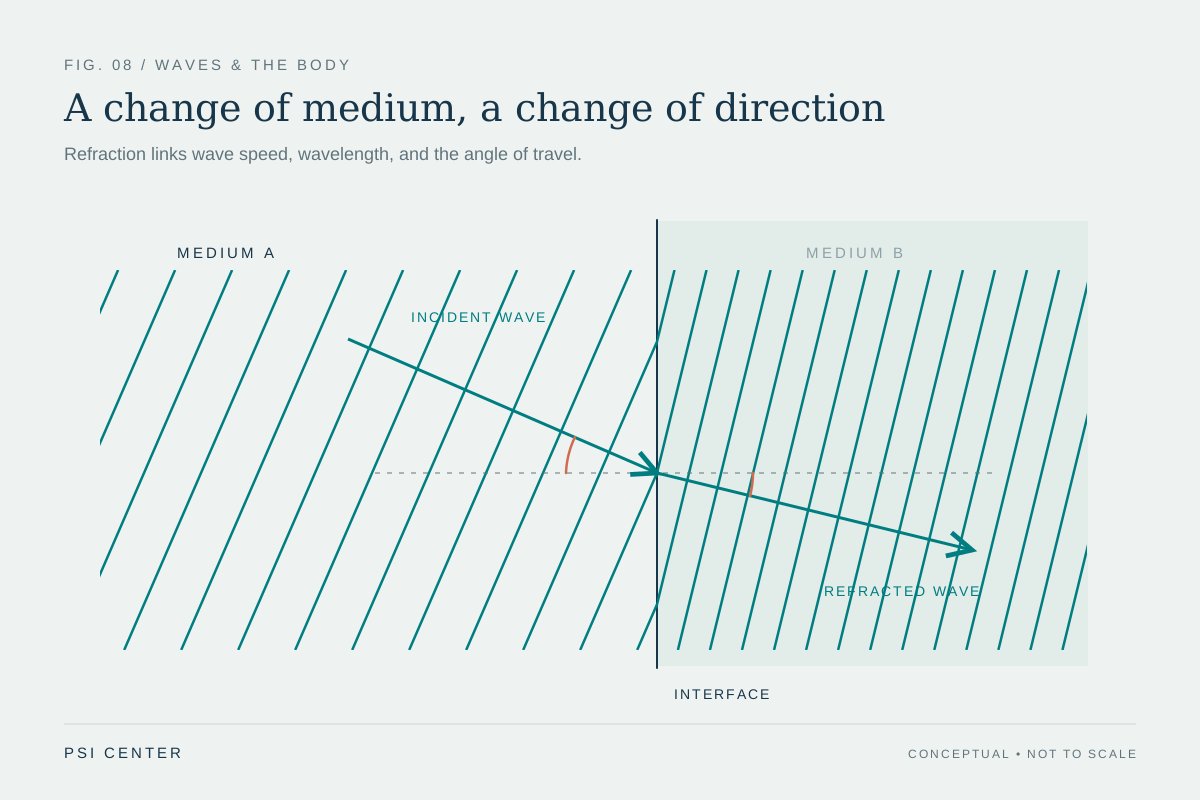
Explore the physics: an explanatory diagram
Sources & further reading
- Ultraviolet Radiation FDA
- Electromagnetic Fields and Cancer National Cancer Institute
Prepared for the independent PSI Center reading library. About edition dates and source checking.
This explainer describes scientific principles. It does not assess individual treatment choices.