How can shining light on a drug help damage a tumor? In photodynamic therapy, the light does not do the job alone. A photosensitizer absorbs light at a suitable wavelength and transfers that energy into chemistry involving nearby oxygen. The resulting reactive oxygen can injure cells. This makes oxygen a working ingredient, while light supplies a local switch that helps confine activity to an illuminated area. [1]
Light excites the sensitizer
A photosensitizer is a molecule that absorbs light and enters an excited energy state. In photodynamic therapy, the absorbed energy can be transferred to oxygen, producing an oxygen radical, a highly reactive form of oxygen that can damage nearby cells. The sequence is physical and chemical: light reaches the sensitizer, the molecule changes energy state, and oxygen participates in the reaction that injures tissue. [1]
A mental experiment helps: imagine the photosensitizer as a small solar collector placed among cells. Without the right light, it remains mostly inactive for the treatment purpose; without oxygen, one key pathway for generating the damaging species is missing. The combination lets treatment be localized by choosing where light is applied, though normal cells in that area can also be affected.
The drug and light must meet
PDT commonly involves two stages. First, a photosensitizer is given by mouth, applied to skin, or delivered intravenously depending on the treatment site. After a period during which much of the drug leaves normal cells while remaining in cancer or precancer cells, light is directed at the area. The timing and delivery route shape where drug and illumination overlap. [1]
For a skin lesion, light can be aimed directly at the surface. For a tumor in an airway or another internal site, a clinician may guide a fiber optic cable through an endoscope to deliver light. The point is not simply to illuminate the body from outside: tissue scatters and absorbs light, limiting how deep it can penetrate. NCI describes the reach as about one centimeter, which restricts PDT’s usefulness for large or deep tumors. [1]
Oxygen makes the reaction local and conditional
Because oxygen participates in the cell-damaging chemistry, its availability in tissue can affect the reaction. The therapy is therefore not just “light kills cells.” The photosensitizer’s location, wavelength and delivery of light, and local oxygen all contribute to what occurs. PDT can also damage tumor blood vessels and may prompt an immune response, but those effects do not remove the basic dependence of the photochemical process on oxygen. [1]
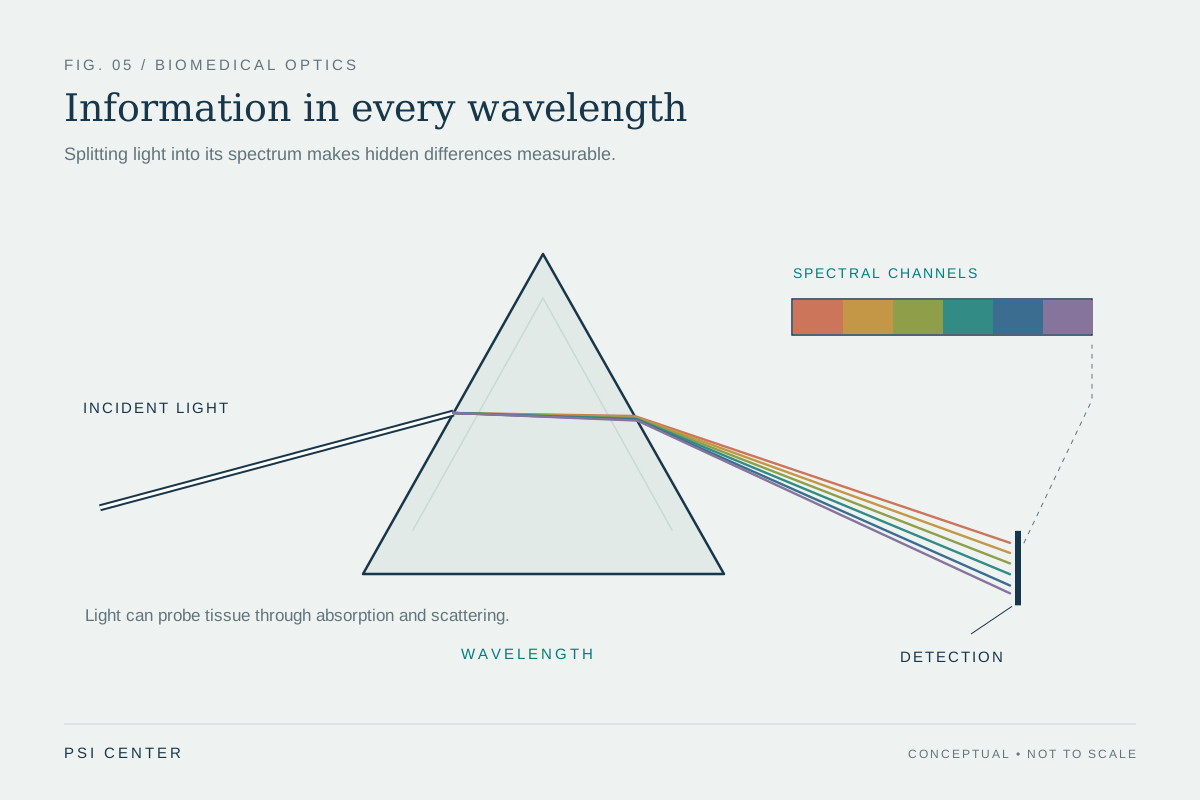
Optical imaging provides a broader example of how light can reveal tissue properties: absorption, scattering, reflection, and emission each carry information. Near-infrared methods can measure properties such as hemoglobin concentration and blood oxygen saturation in soft tissue. Those measurements are not identical to PDT or a direct guarantee of treatment response, but they illustrate why light-tissue interactions depend on both the material and the wavelengths involved. [2]
A local treatment with real boundaries
PDT is used for specified cancers and precancers and can also relieve symptoms when some tumors block passages such as airways. Its relative selectivity comes from combining drug accumulation with focused illumination, not from a perfect boundary between abnormal and healthy tissue. Nearby normal cells can be harmed, and reported effects include pain, swelling, burns, or other site-dependent symptoms. Some photosensitizers can also leave skin and eyes unusually sensitive to light for weeks. [1]
Researchers are exploring ways to improve photosensitizers and light delivery, including approaches that might reach deeper tissue. These efforts reflect a physical constraint: light loses intensity as it travels through tissue, while oxygen and sensitizer must be present where the reaction is intended. PDT is an established treatment in defined uses, but its chemistry and optical reach set limits on where it can work. [2]
Explore the physics: an explanatory diagram
Sources & further reading
- Photodynamic Therapy to Treat Cancer National Cancer Institute
- Optical Imaging NIBIB
Prepared for the independent PSI Center reading library. About edition dates and source checking.
This explainer describes scientific principles. It does not assess individual treatment choices.