Why doesn’t shining a bright lamp on a tumor count as treatment? Photodynamic therapy works only when light meets a photosensitizing drug in the right place. The drug absorbs a particular wavelength and transfers energy into an oxygen-dependent reaction that can damage cells. The lamp is one part of a coordinated treatment, not the treatment by itself.
The drug creates light sensitivity
A photosensitizer is a drug that becomes active when illuminated with an appropriate wavelength of light. Depending on the treatment site, it may be taken by mouth, applied to skin, or delivered through a vein. After a waiting interval, the drug is more concentrated in abnormal cells than in many normal cells; the timing and method depend on the therapy used. [1]
When the photosensitizer absorbs light, it can produce reactive oxygen that damages cells. It may also injure blood vessels feeding a tumor and can stimulate an immune response. These mechanisms explain why light and drug must coincide: without the sensitizer, the relevant chemistry is absent; without reaching light, the sensitizer is not activated as intended.
Light must reach the target
For a surface lesion, clinicians can direct light onto the treated area. For a tumor in an internal lining, such as an airway or throat, a physician can use an endoscope and a fiber-optic cable to deliver light to the site. The delivery method follows anatomy: the goal is to illuminate the tissue where the drug has accumulated. [1]
The light’s limited reach is a major constraint. NCI notes that the light used in PDT cannot pass through more than about one centimeter of tissue. That makes the approach most suited to tumors on or just beneath the skin, or on the lining of internal organs and cavities. Large or deep tumors may not receive enough light throughout their volume. [1]
Local action has tradeoffs
Because photosensitizers tend to build up in abnormal cells and light can be focused, PDT can limit damage to healthy tissue and may avoid scarring in some uses. Yet the treatment area can still include normal cells. Burns, swelling, pain, and other local effects can occur, with additional effects depending on the site treated. [1]
The tradeoff is a form of spatial selectivity: the drug influences where chemistry is possible, and the light influences where activation occurs. Neither boundary is perfect. Some photosensitizers can also leave skin and eyes unusually sensitive to light for an extended period, so the specific agent and treatment protocol matter. [1]
Established uses and continuing research
PDT is an established local treatment for several listed cancers and precancers, including actinic keratosis, some skin cancers, Barrett esophagus, and certain lung or esophageal cancers. It can also relieve symptoms when tumors block airways or the esophagus. Its role depends on the cancer type, location, and treatment goal rather than a general ability to destroy any tumor. [1]
Researchers are investigating ways to improve photosensitizers, target them more precisely, and use light that can reach deeper tissue. Those goals mark ongoing research, not proof that current PDT can treat deep or large tumors. Clinical trials test particular approaches and questions in people; a study of one use cannot automatically establish benefit for another. [2] PDT is therefore best understood as a drug-and-light system whose chemistry can be useful within a defined reach.
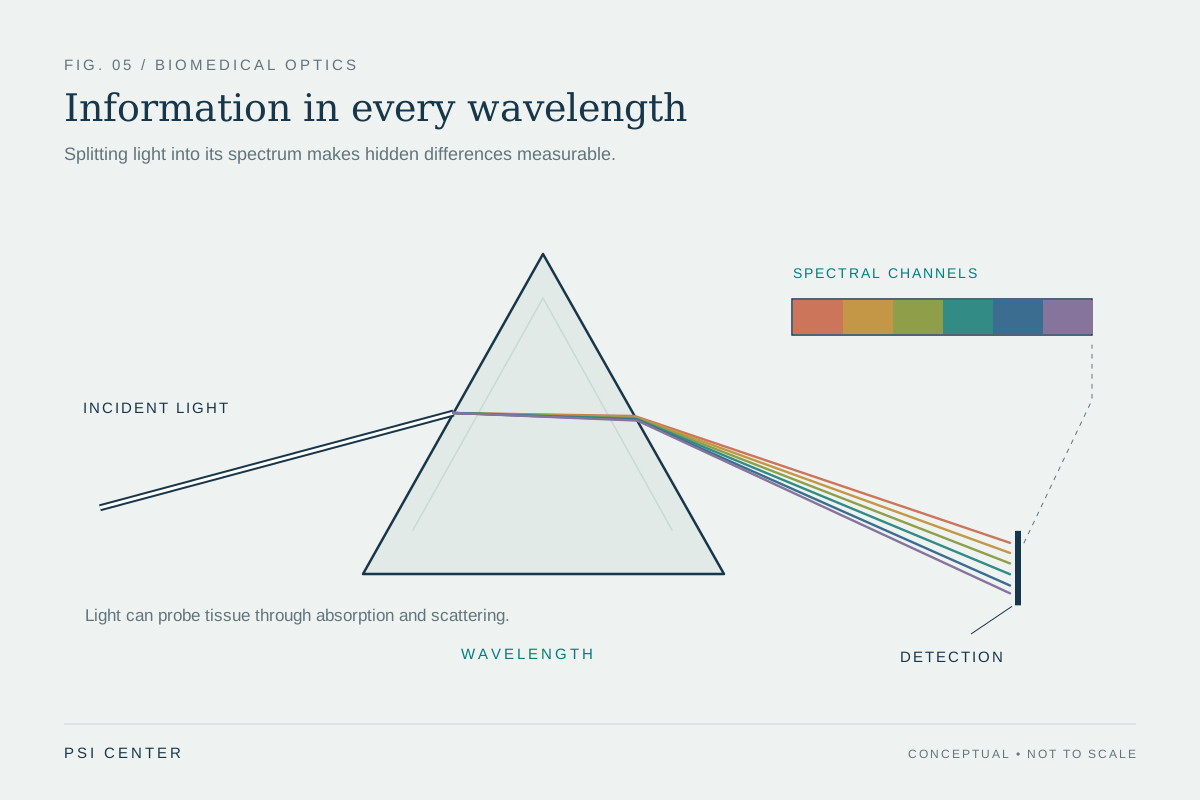
Explore the physics: an explanatory diagram
Sources & further reading
- Photodynamic Therapy to Treat Cancer National Cancer Institute
- Clinical Trials: What Are the Phases? National Cancer Institute
Prepared for the independent PSI Center reading library. About edition dates and source checking.
This explainer describes scientific principles. It does not assess individual treatment choices.