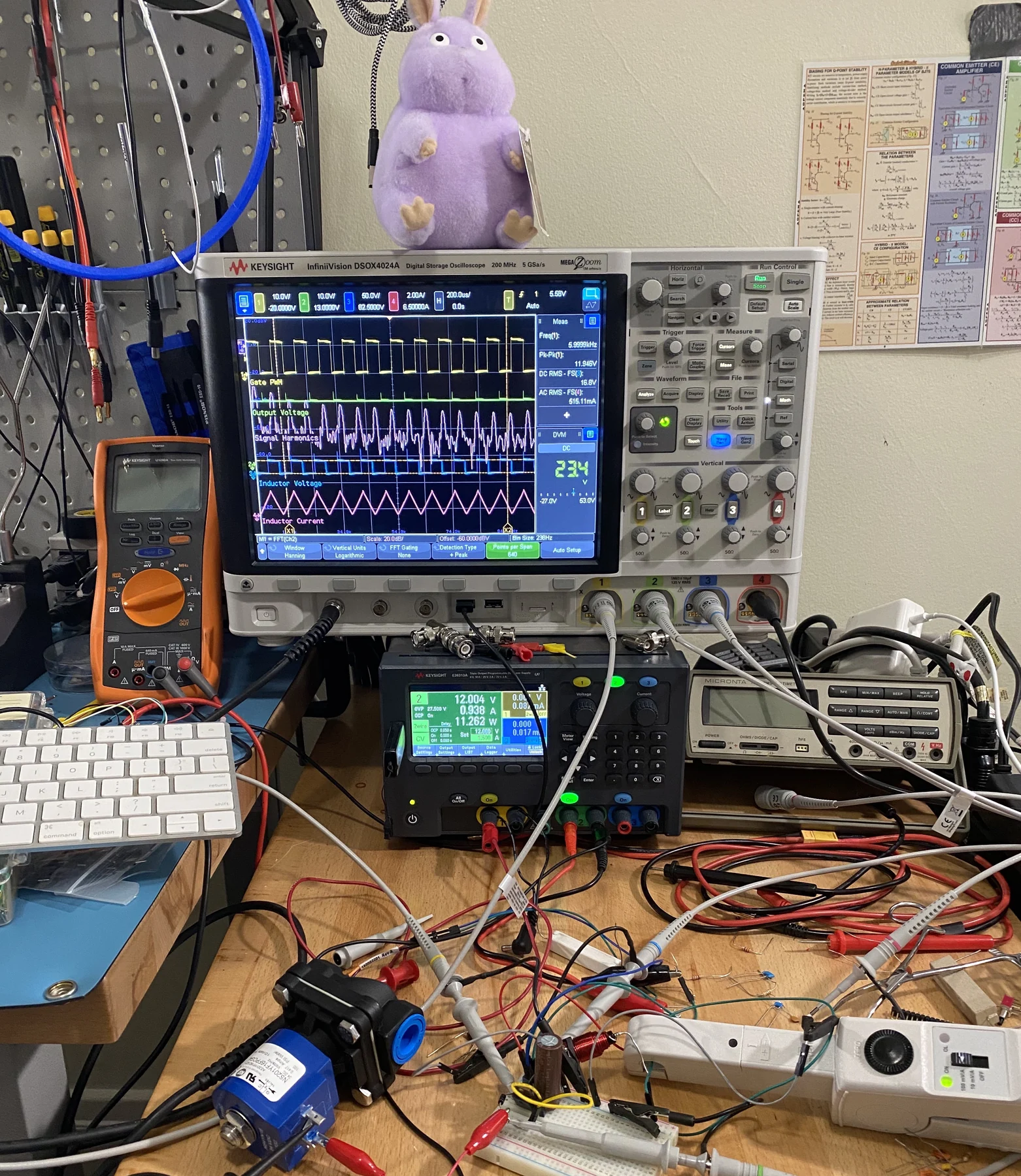
If a bathroom scale displays 68.427 kilograms, does it know your mass to the nearest gram? The extra digits may describe how the display is formatted rather than how well the instrument measures. Measurement has two separate questions: how finely a value is reported and how close that value is to the quantity we want to know. More decimal places answer only the first question.
Digits describe a display, not truth
A digital instrument converts a signal into a numerical readout. The smallest step it can show is its resolution. If a scale rounds an internal signal to thousandths of a kilogram, it can print three decimal places. But if the sensing mechanism, calibration, or conditions of use only support a much broader range of possible values, the last digits do not carry reliable information.
Picture a ruler with millimeter marks that has been photographed badly and enlarged on a screen. The screen may let you estimate a location to many decimal places, but the blur in the original image has not disappeared. In the same way, software can calculate a number with many digits from uncertain inputs. Precision in arithmetic does not restore information that the measurement process never captured.
Accuracy and precision are different
Repeated readings can cluster tightly while all missing the reference value in the same direction. That pattern is precise but biased. Conversely, readings may scatter around the reference, with no large systematic offset, yet be too variable for a particular task. Accuracy describes closeness to the quantity’s accepted value; precision describes repeatability or spread. Neither is communicated by the number of digits alone.
In health measurement, a pulse sensor might repeatedly report the same rate under steady conditions, but that repeatability does not alone demonstrate that its reading is correct. Sensors detect physical or chemical inputs and translate them into reported data; examples include pulse oximeters using light absorption and glucose monitors sensing glucose in fluid between cells [2]. The measurement method, conditions, and intended use all influence how a number should be interpreted.
Uncertainty is part of the result
Measurement uncertainty describes the range of values reasonably associated with a result, given what is known about the measurement process. It can include contributions from the instrument, reference standards, environmental conditions, sample variation, and the procedure. NIST provides guidance and tools for evaluating and expressing uncertainty, including approaches for combining uncertainty components [1]. The central idea is that a result is more informative when its limitations are made explicit.
Consider two thermometers that both display 37.0 degrees. One has been checked against a suitable reference and is used under controlled conditions; the other has an unknown calibration history and is held near a heat source. The digits match, but the evidence behind them differs. A measurement result should therefore be understood with its method and uncertainty, not detached from the circumstances that produced it.
Fit the measurement to the question
Even a traceable result may not be fit for a particular purpose. Metrological traceability connects a result to a reference through a documented chain of calibrations, each contributing uncertainty; NIST explicitly notes that traceability alone does not guarantee fitness for purpose [3]. If a clinical or research question requires distinguishing a tiny change, the measurement uncertainty must be small enough to support that distinction. If the task only calls for a broad trend, a less exact reading may still be useful.
When looking at a number, ask what was measured, how the instrument was calibrated, what uncertainty applies, and whether that uncertainty matters for the decision at hand. A screen full of decimals can be helpful when the underlying method supports them. Without that support, extra digits are decoration. The trustworthy result is not the one with the longest decimal tail, but the one whose precision, uncertainty, and intended use are honestly matched.
Sources & further reading
Prepared for the independent PSI Center reading library. About edition dates and source checking.
This explainer describes scientific principles. It does not assess individual treatment choices.