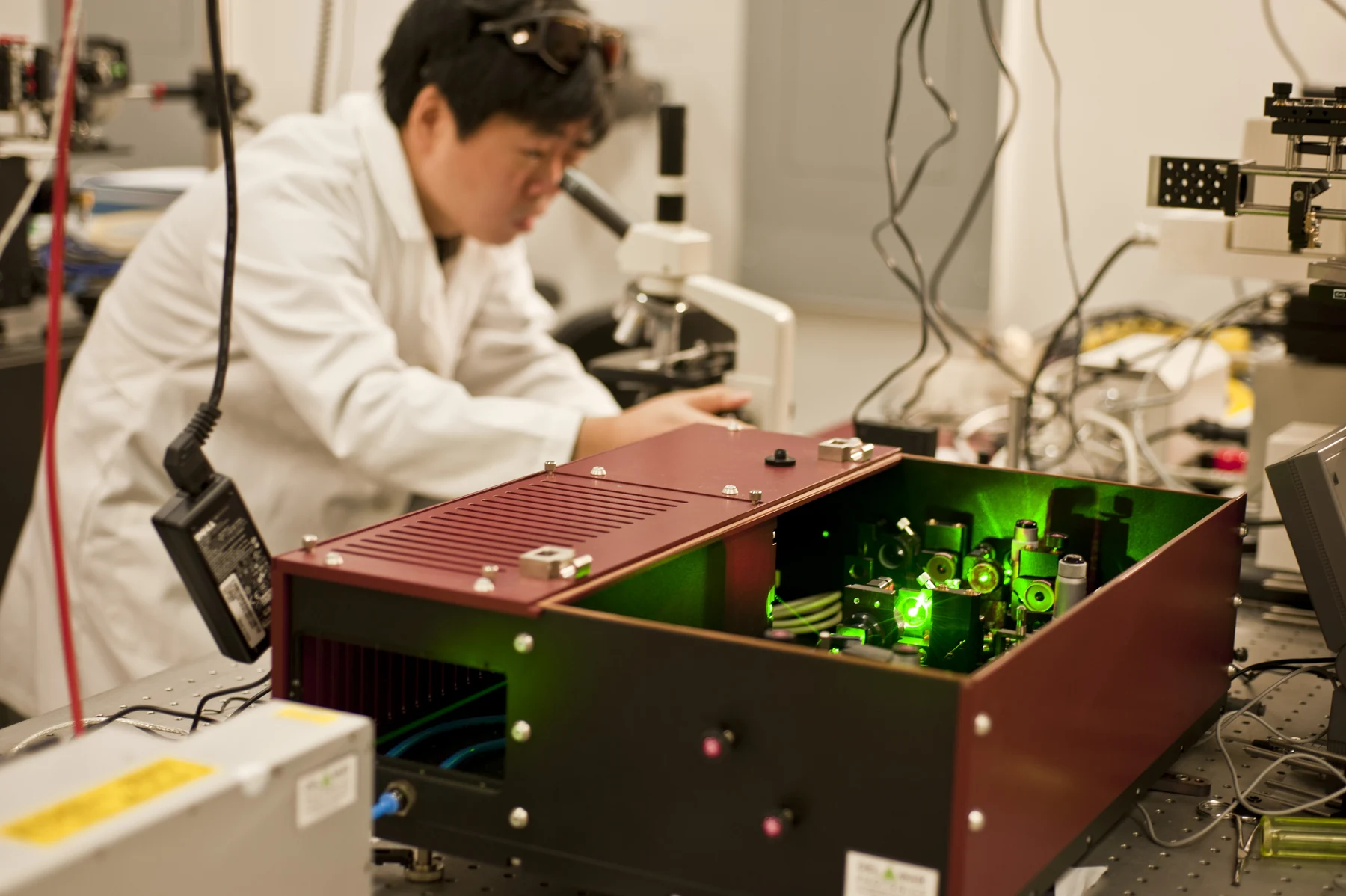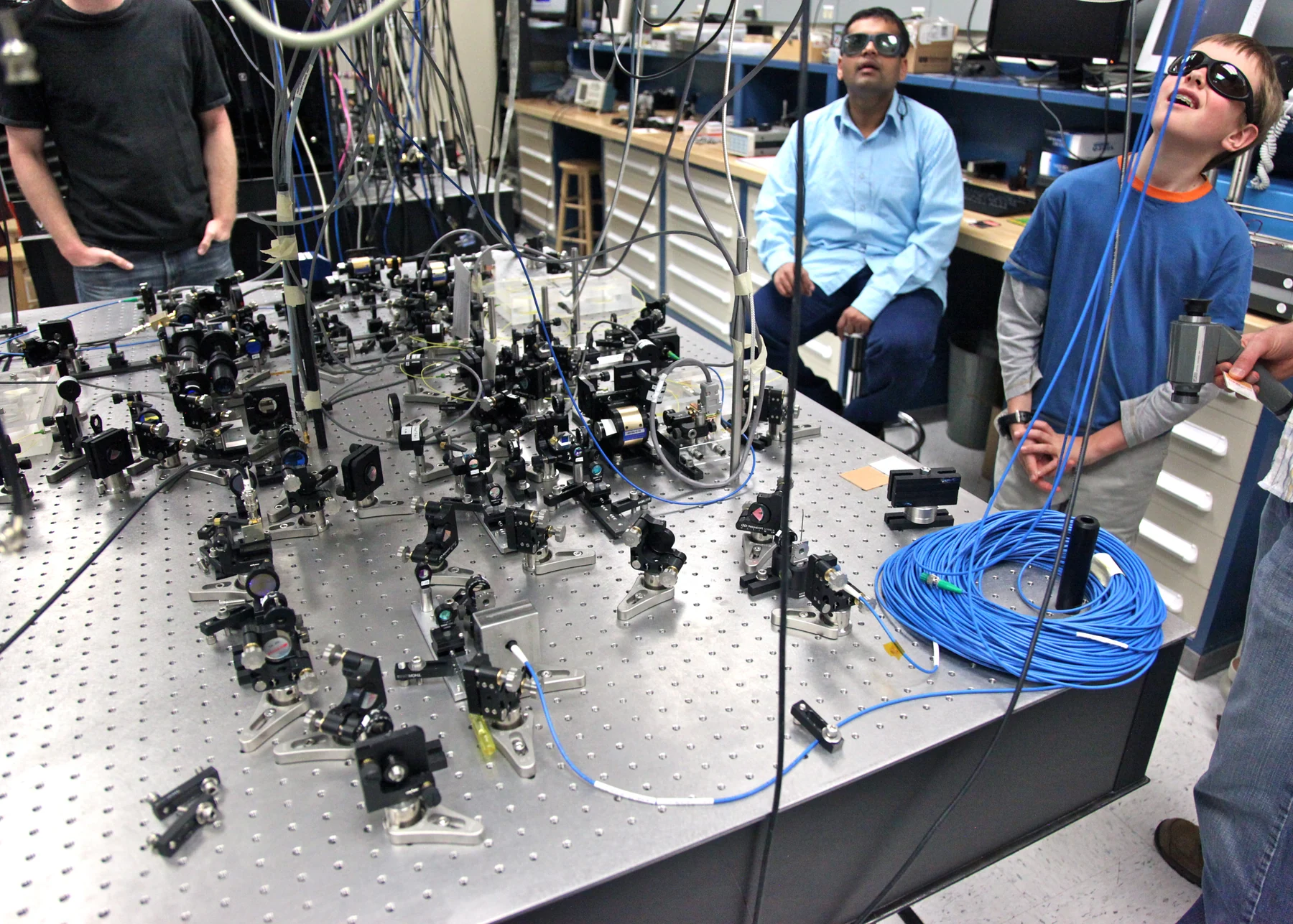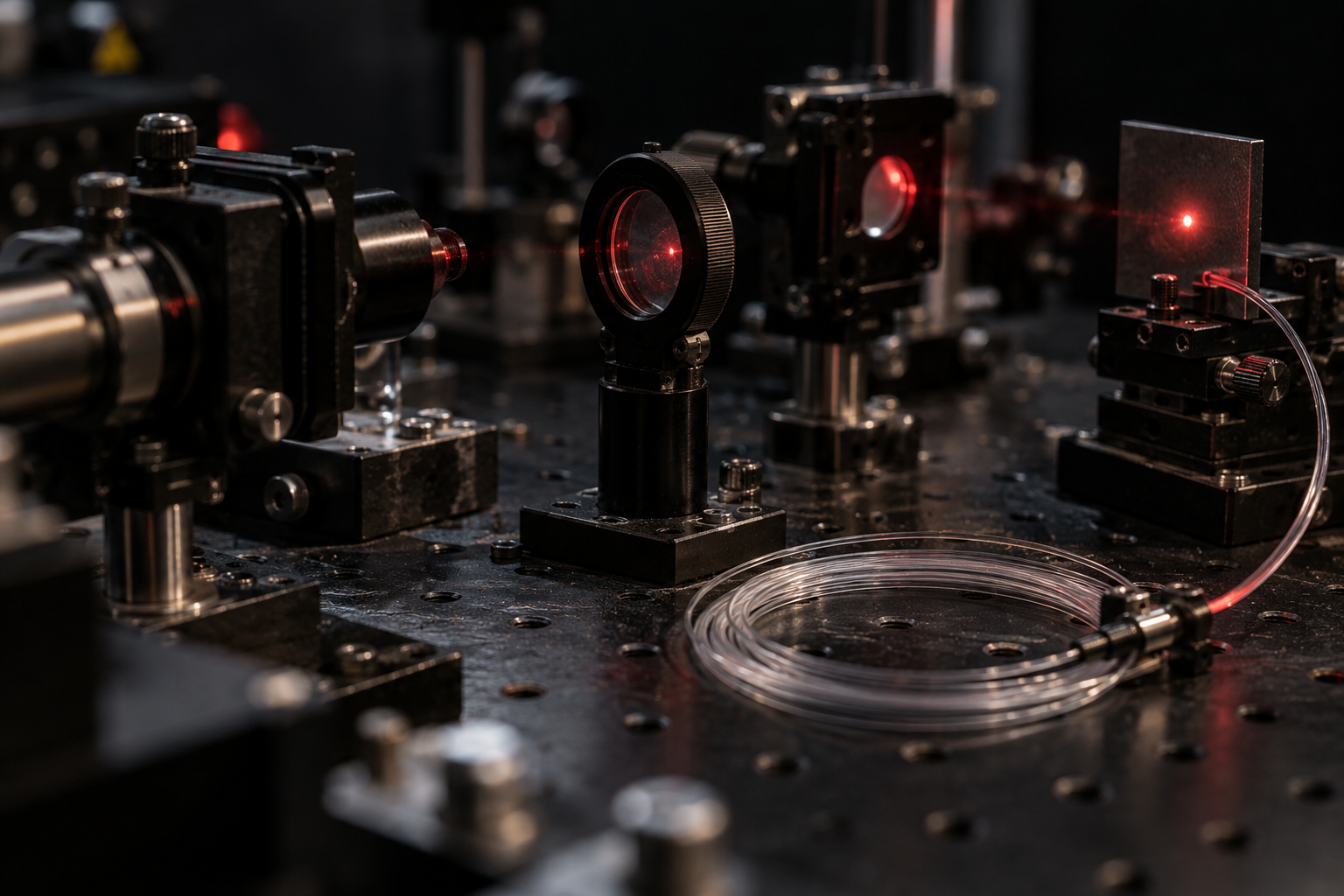
Why can one beam be harmless at a distance while another can injure an eye almost instantly? “Laser” describes a way of producing concentrated light, not one fixed level of danger. Wavelength determines what kind of light reaches the body, while beam intensity and exposure determine how much energy arrives. The eye’s focusing optics add another factor: they can concentrate incoming light onto a small, vulnerable area.
What makes laser light concentrated
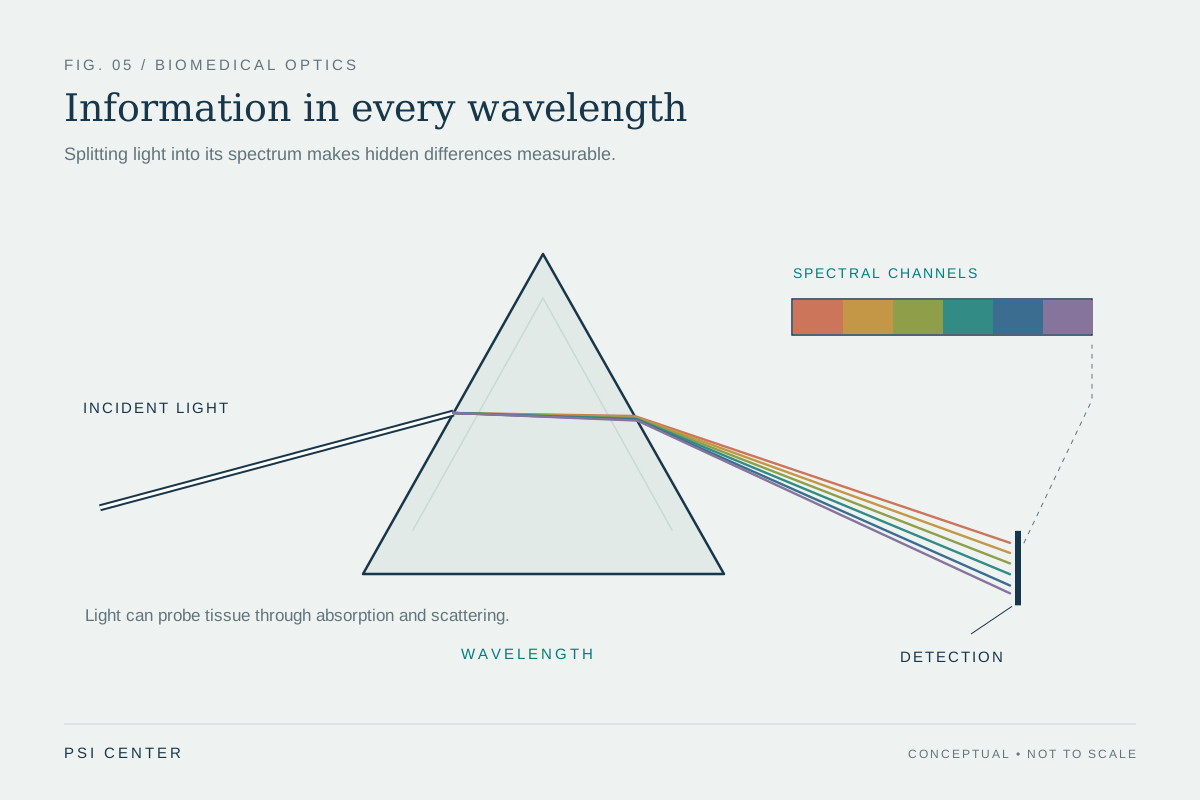
Ordinary light sources emit many wavelengths in many directions. A laser amplifies light at a specific wavelength into a narrow, directed beam, which can remain concentrated over distance [1]. Wavelength is the distance between successive wave peaks; it distinguishes ultraviolet, visible, and infrared light, among other parts of the electromagnetic spectrum [2].
Concentration matters because energy delivered to a small area can be intense even when the beam is narrow. A useful mental experiment is to compare a ceiling lamp illuminating a whole room with a flashlight aimed at one spot. A laser makes a more organized and focused beam than either everyday example. Its effects depend on how much energy reaches tissue, how it is distributed, and how long the exposure lasts.
Eyes and skin do not respond identically
The eye can focus visible and some infrared light onto the retina, concentrating energy on tissue needed for vision. Direct viewing can therefore present a serious hazard, with risk depending on the device and exposure. The FDA’s hazard classes reflect increasing potential for injury: higher classes generally mean greater power and greater potential harm if used improperly. Some classes become more hazardous when viewed through magnifying optics [1].
Skin exposure follows a different path. Depending on wavelength and intensity, energy may be absorbed at the surface or penetrate farther. Ultraviolet radiation offers a clear example of wavelength-specific effects: UVB primarily reaches the outer skin layer, while UVA can penetrate into the dermis [2]. UVC has shorter wavelengths and is absorbed superficially, but artificial UVC sources can cause skin burns and painful eye injuries. So “less penetration” does not mean “no hazard.”
Exposure conditions change the risk
A beam’s wavelength alone cannot predict injury. Output power, beam area, distance, duration, and whether the beam is direct or reflected all influence exposure. For some high-class lasers, even reflected beams can be hazardous to eyes or skin; the FDA notes that Class IV products may also create a fire hazard [1]. Optical aids such as binoculars can increase risk for certain classes by collecting more light and directing it into the eye.
Ultraviolet sources add their own exposure variables. Some UVC lamps may also emit UVB, and some generate ozone that can irritate breathing passages [2]. In clinical phototherapy, UV exposure is deliberately monitored by trained health professionals because the treatment still carries UV side effects even when intended to help particular diseases [2]. The key point is that the same broad category of light can have different effects under different wavelengths and exposure conditions.
Class labels help, but controls still matter
Laser classes communicate hazard levels and support engineering controls and warnings. They are a starting point for understanding a product, not a guarantee that every use is safe. The FDA explicitly notes that controls cannot be completely effective if lasers are used improperly [1]. Medical lasers also have to meet medical-device requirements, alongside laser-product safety rules [1].
The physical chain is straightforward: a laser’s wavelength sets the light’s photon energy and how it interacts with tissue; its beam concentrates that energy in space; and exposure conditions determine how much reaches a sensitive structure. That is why safety depends on more than color or a label. A visible pointer, an industrial cutter, a medical laser, and a UVC lamp all use concentrated or selected light, but their intended uses and hazards differ substantially.
Explore the physics: an explanatory diagram
Sources & further reading
Prepared for the independent PSI Center reading library. About edition dates and source checking.
This explainer describes scientific principles. It does not assess individual treatment choices.