How can a lotion change what sunlight does to skin if the ultraviolet rays are invisible? The key is to treat sunscreen as an optical filter placed at the boundary between light and tissue. Ultraviolet radiation carries energy in photons, and different wavelengths penetrate and affect skin in different ways. A filter can absorb or reflect part of that incoming radiation before it reaches living tissue, but no single label captures every aspect of protection.
Invisible light still has a wavelength
Ultraviolet, or UV, radiation is electromagnetic energy between visible light and X-rays. Like other electromagnetic radiation, it can be described as waves and as packets of energy called photons. Wavelength is the distance between repeating wave peaks; shorter wavelengths correspond to more energetic photons. UV itself includes UVA, UVB, and UVC bands, with UVA having the longest wavelengths and UVC the shortest [2].
For a mental picture, imagine two ripples arriving at a pond’s edge, one with widely spaced crests and another with closer crests. Their spacing differs, and so does the way each interacts with material. In skin, UVB reaches the outer epidermis, while longer-wavelength UVA can penetrate into the dermis. Both UVA and UVB can damage skin; sunburn is a short-term sign of overexposure, while prolonged exposure contributes to premature aging and skin cancer [2].
A filter changes what gets through
Sunscreen active ingredients protect by absorbing or reflecting UV radiation at the skin’s surface before it can cause damage. The inactive ingredients form the product around those active components, but are not themselves the ingredients identified as providing UV protection [1]. Thinking in optical terms clarifies why sunscreen is not a wall that makes sunlight vanish: it alters the radiation that reaches skin, and the amount of protection depends on how the product is used and how much coverage it provides.
Sun protection factor, or SPF, is based on testing how much UV exposure is needed to cause sunburn with a product compared with without it. Because sunburn testing primarily reflects UVB protection, SPF alone does not describe protection across the whole UV range. Broad-spectrum labeling indicates protection against both UVA and UVB [1].
Why SPF is not a clock
An SPF number is sometimes mistaken for a multiplier of safe time in the sun. That interpretation misses the physics: the test compares amounts of exposure associated with sunburn, while the rate of exposure changes with conditions. The sun’s intensity varies with time of day and geographic location, and the amount reaching a person also depends on factors such as reflection from surfaces [1] [2].
Picture the same patch of skin under a midday sun and in the early evening. The clock time spent outside could match, but the incoming UV dose need not. Snow, sand, pavement, and water can reflect UV, adding radiation from directions other than the direct solar beam [2]. SPF therefore is not a promise that a person can remain outside for a fixed number of hours without burning [1].
Protection depends on the whole exposure
A filter only works where it is present and while it remains effective. Gaps in coverage leave skin exposed, and sunscreen eventually washes off. FDA guidance says to use broad-spectrum sunscreen with SPF 15 or higher as directed, reapply at least every two hours and more often after swimming or sweating, and combine sunscreen with other protective measures such as clothing and shade [1].
The optical-filter analogy also explains why sunscreen labels answer specific questions rather than every question about sunlight. UV exposure can occur on cloudy days, and its intensity depends on geography, altitude, season, time, weather, and reflective surroundings [2]. A broad-spectrum product addresses UVA and UVB at the skin surface; it does not make those environmental factors disappear.
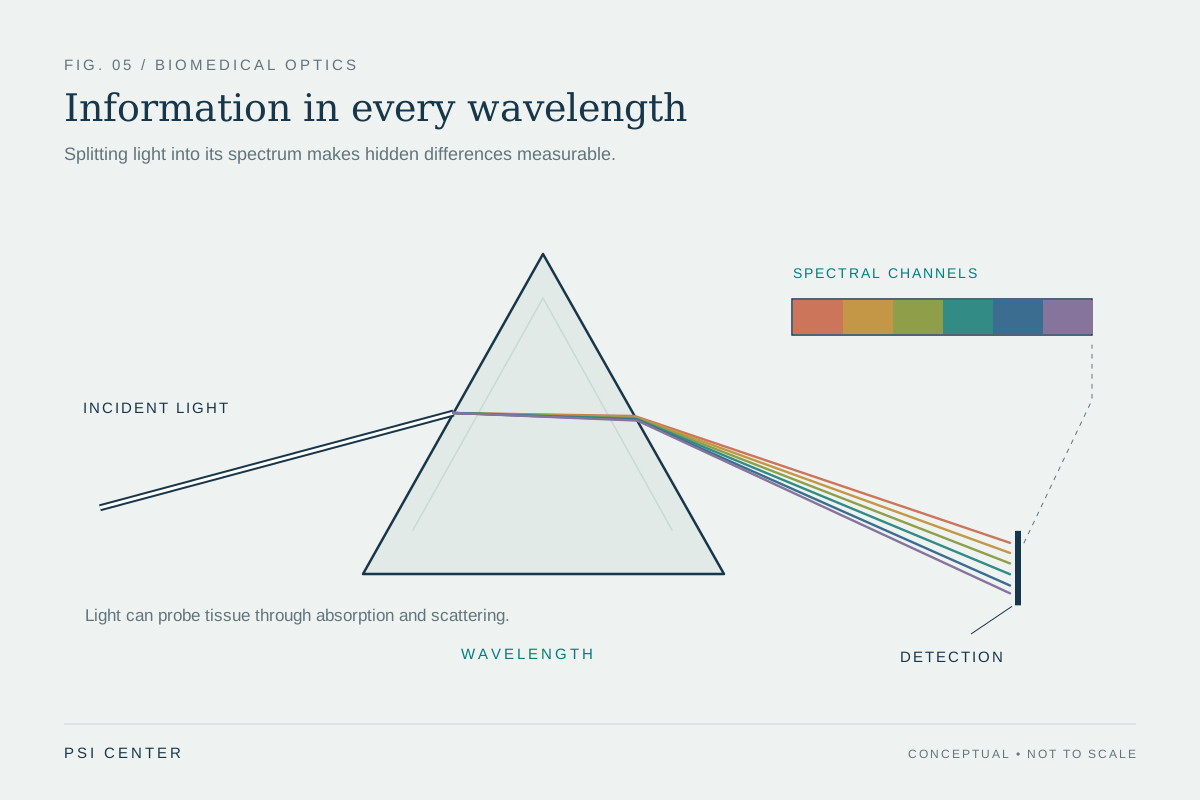
Explore the physics: an explanatory diagram
Sources & further reading
Prepared for the independent PSI Center reading library. About edition dates and source checking.
This explainer describes scientific principles. It does not assess individual treatment choices.