What is coming out of a medical plasma jet: a tiny flame, a stream of hot gas, or something else? The visible glow can make the device look familiar, but the physics is different. Plasma is a gas in which some electrons have been freed from atoms or molecules, leaving a mixture of charged particles and neutral ones. In some medical devices, that partly ionized mixture is produced near ordinary room conditions, making its chemistry more important than its resemblance to fire.
The glow marks charged matter
In an ordinary gas, electrons are usually bound to atoms or molecules. Supply enough energy and some break free. The result is plasma: a mixture containing negatively charged electrons, positively charged ions and neutral particles. Because charges can move, plasma conducts electricity and responds to electric and magnetic fields. Lightning is a familiar natural example; the plasma in a medical jet is a deliberately generated, much smaller one. [1]
A flame is mainly a chemical reaction that releases heat and light. A plasma jet, by contrast, is defined by its free charges. The two can both glow, and a plasma device can warm its surroundings, but brightness alone does not tell us whether something is a flame or a plasma. The useful mental picture is not a miniature blowtorch but a gas whose particles have been electrically rearranged.
How a jet reaches a surface
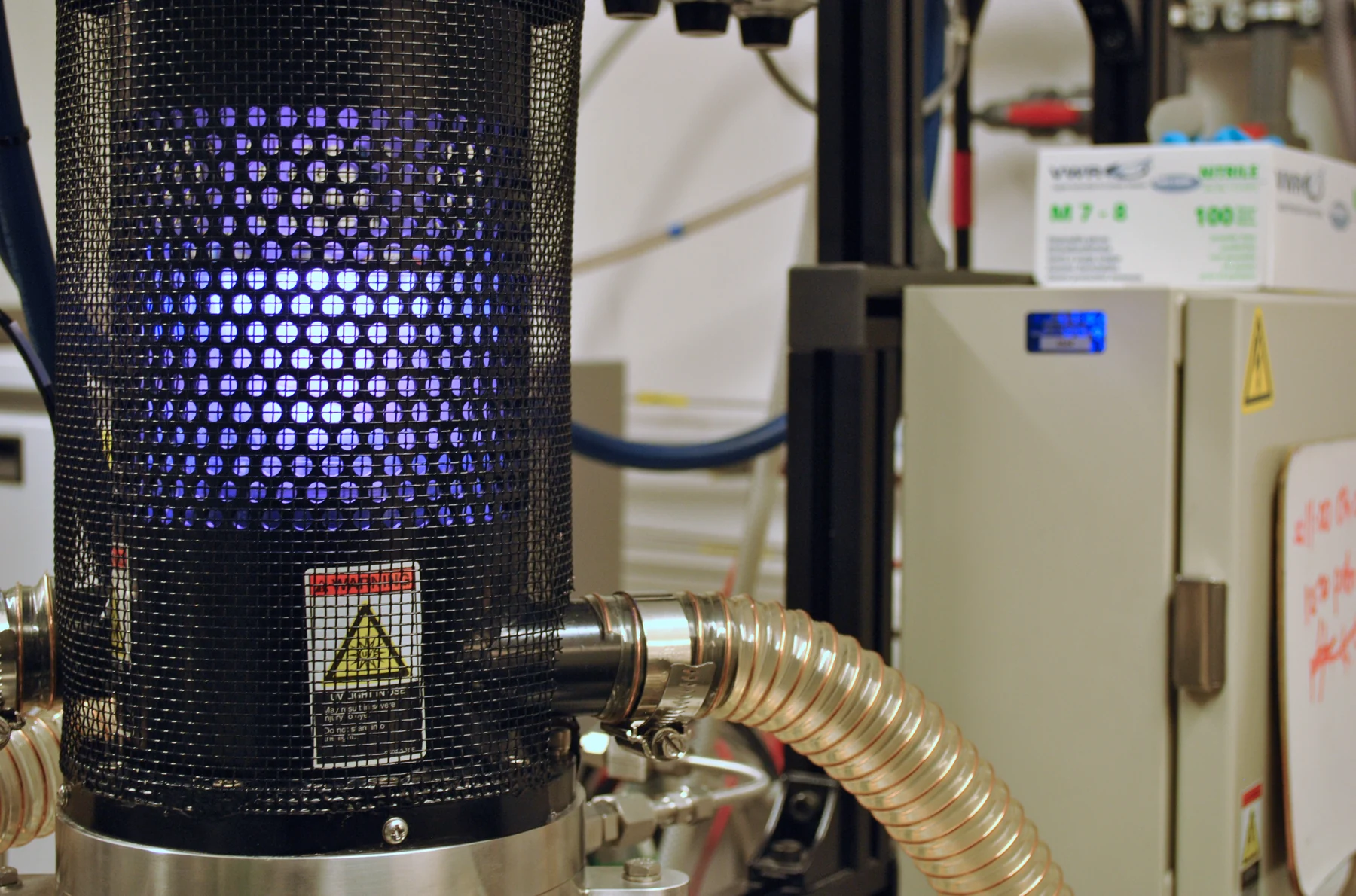
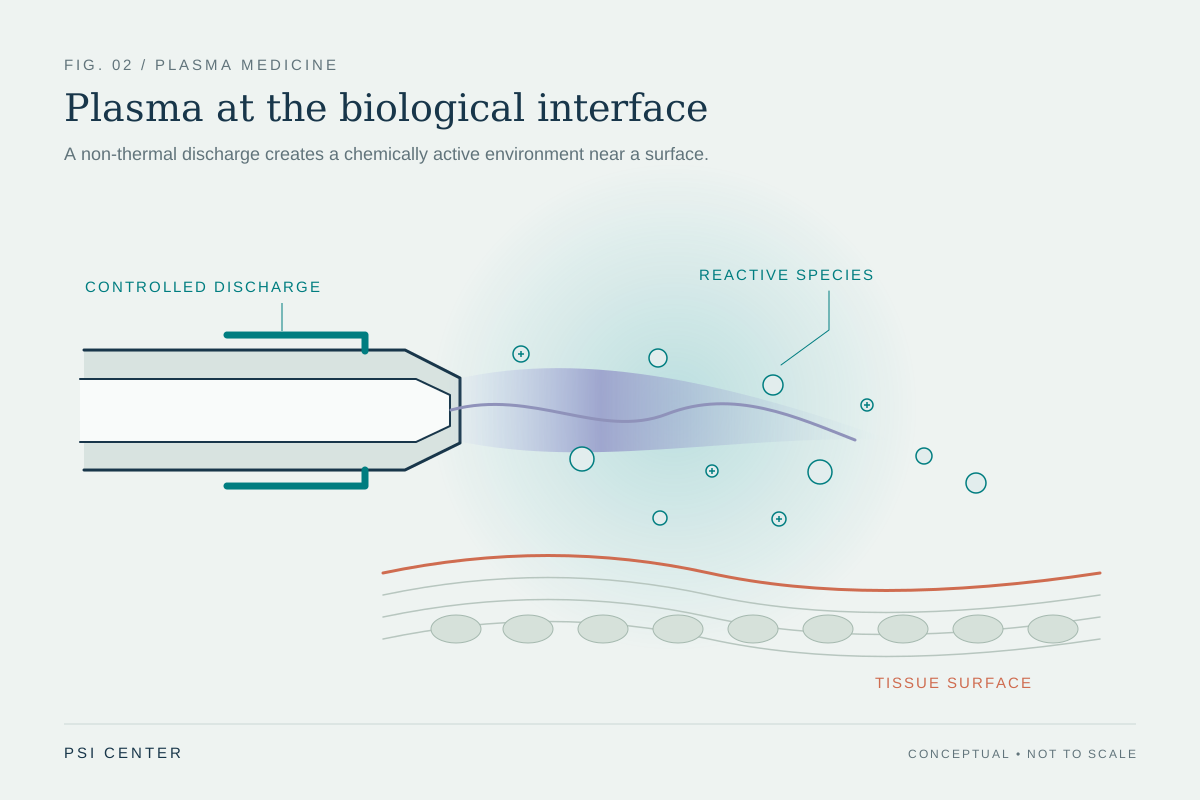
A cold atmospheric-pressure plasma source makes a partly ionized gas outside a vacuum chamber, under pressure close to the surrounding air. An electrical field supplies energy that frees some electrons. The gas can then carry charged particles and reactive chemical species toward a nearby surface. “Cold” describes the treatment context and gas temperature relative to very hot plasmas; it does not mean the device has no energy or that every point and setting is harmless.
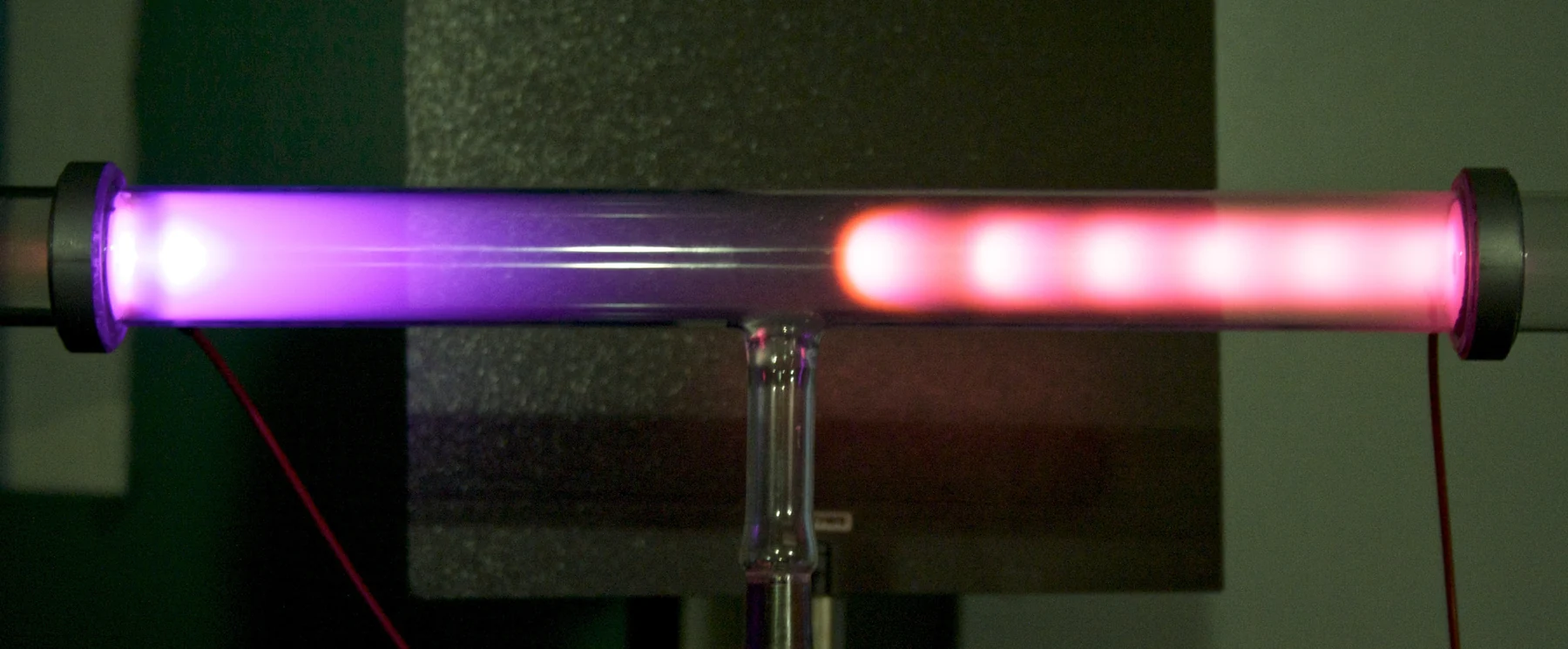
The jet is also not a beam of plasma that stays intact indefinitely. Its constituents interact with surrounding air and the target, so what reaches a surface depends on the source and its operating conditions. A useful comparison is a lit fluorescent tube: both contain plasma, but their geometry, environment and intended effects differ greatly. Plasma’s electrical behavior is common to both; the application determines what that behavior is used to do. [1]
Chemistry meets living tissue
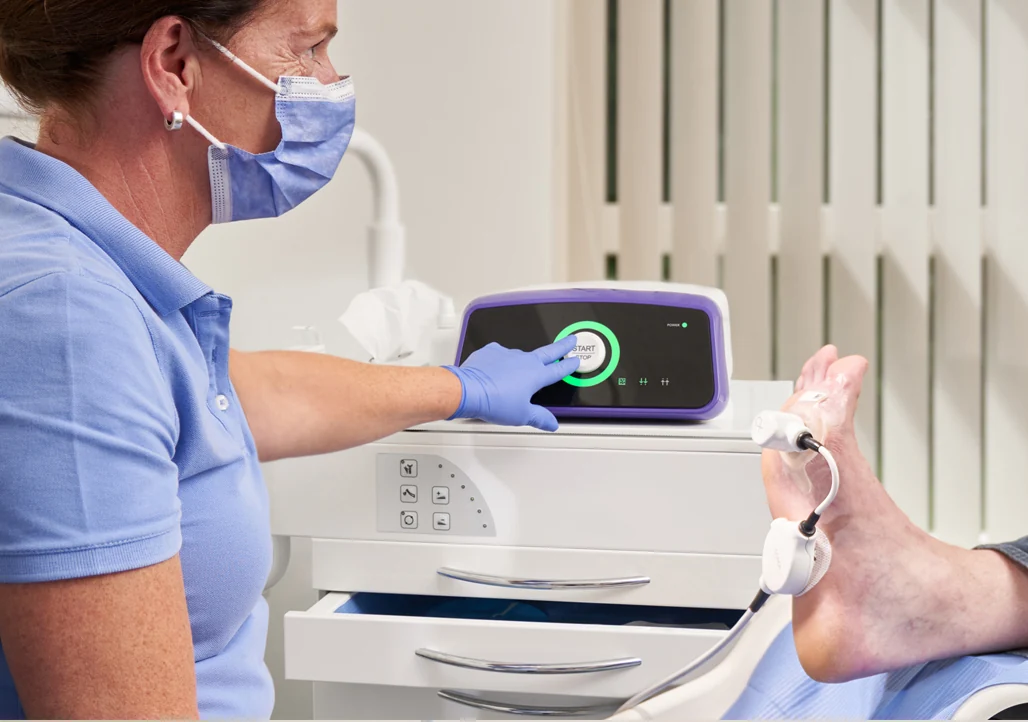
At a wound surface, reactive species produced in or around the plasma can affect microbes and tissue. The Leibniz Institute for Plasma Science and Technology describes cold atmospheric plasma sources as being used to disinfect body surfaces and living tissue, and reports research into their possible influence on wound healing. The proposed interest is therefore not simply heating: it includes chemical interactions at the exposed surface. [2]
That mechanism makes biological effects plausible, but plausibility is not proof of patient benefit. Killing microbes in a dish, changing cell behavior, or observing a tissue response does not by itself show that a treatment reliably closes a chronic wound or improves outcomes in routine care. Results depend on the device, the wound and the clinical setting. The distinction between a laboratory effect and a demonstrated clinical outcome is essential whenever a physical tool is presented as medicine.
Research is not a blanket recommendation
Clinical evidence and recommendations can differ across health systems and patient groups. The INP page describes clinical studies and notes a German guideline recommendation for certain chronic and infected wounds. That report should not be mistaken for universal agreement or for proof that every plasma source works for every wound. Evidence must be judged for the particular condition, device and comparison being studied. [2]
For diabetes-related foot ulcers, the 2023 International Working Group on the Diabetic Foot guideline recommends against using other gases, including cold atmospheric plasma, to promote healing, citing low-certainty evidence at risk of bias. That is a specific recommendation in a specific clinical context, and it underlines why promising device physics cannot substitute for rigorous trials. The tiny glow is a sign of an unusual state of matter; whether a treatment belongs in care depends on clinical evidence, not appearance. [3]
Explore the physics: an explanatory diagram
Sources & further reading
- About Plasmas and Fusion Princeton Plasma Physics Laboratory
- Wound Healing and Antisepsis Leibniz Institute for Plasma Science and Technology
- Guidelines on Interventions to Enhance Healing of Foot Ulcers: 2023 Update International Working Group on the Diabetic Foot
Prepared for the independent PSI Center reading library. About edition dates and source checking.
This explainer describes scientific principles. It does not assess individual treatment choices.