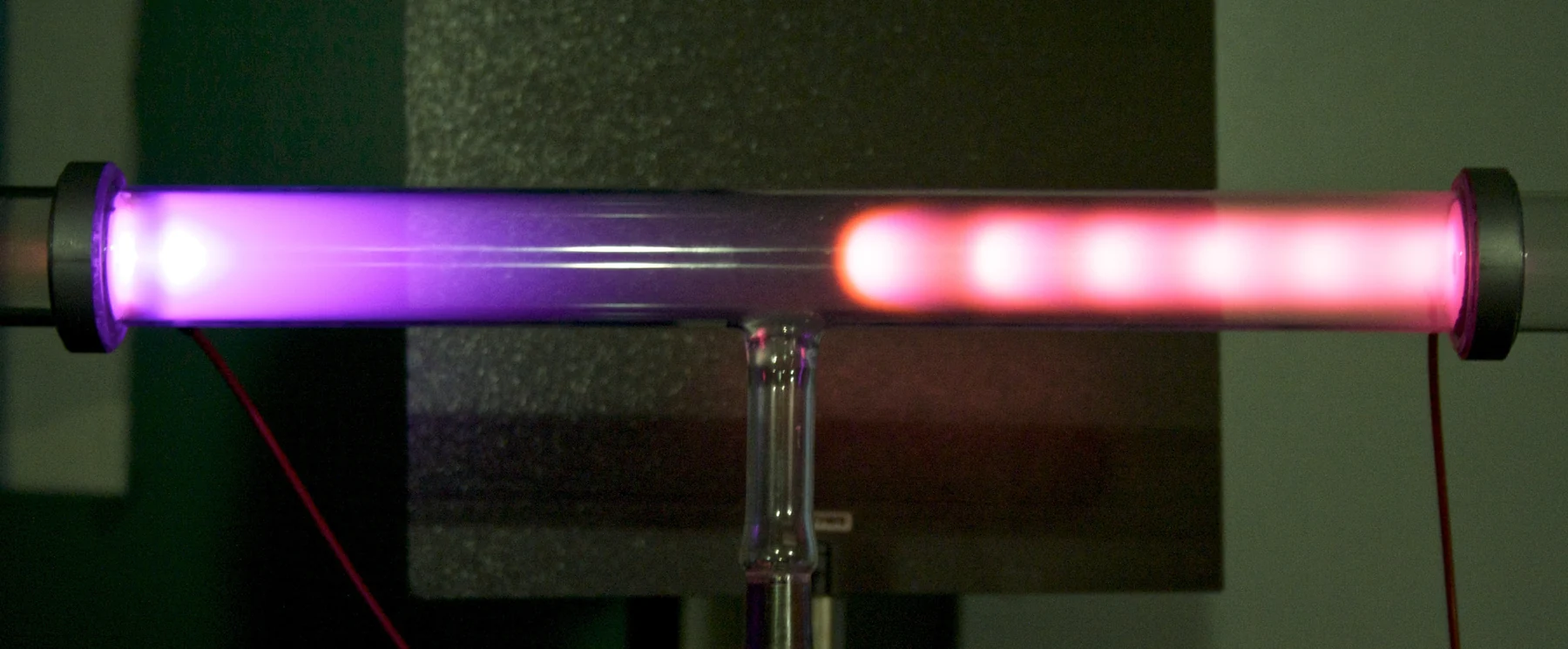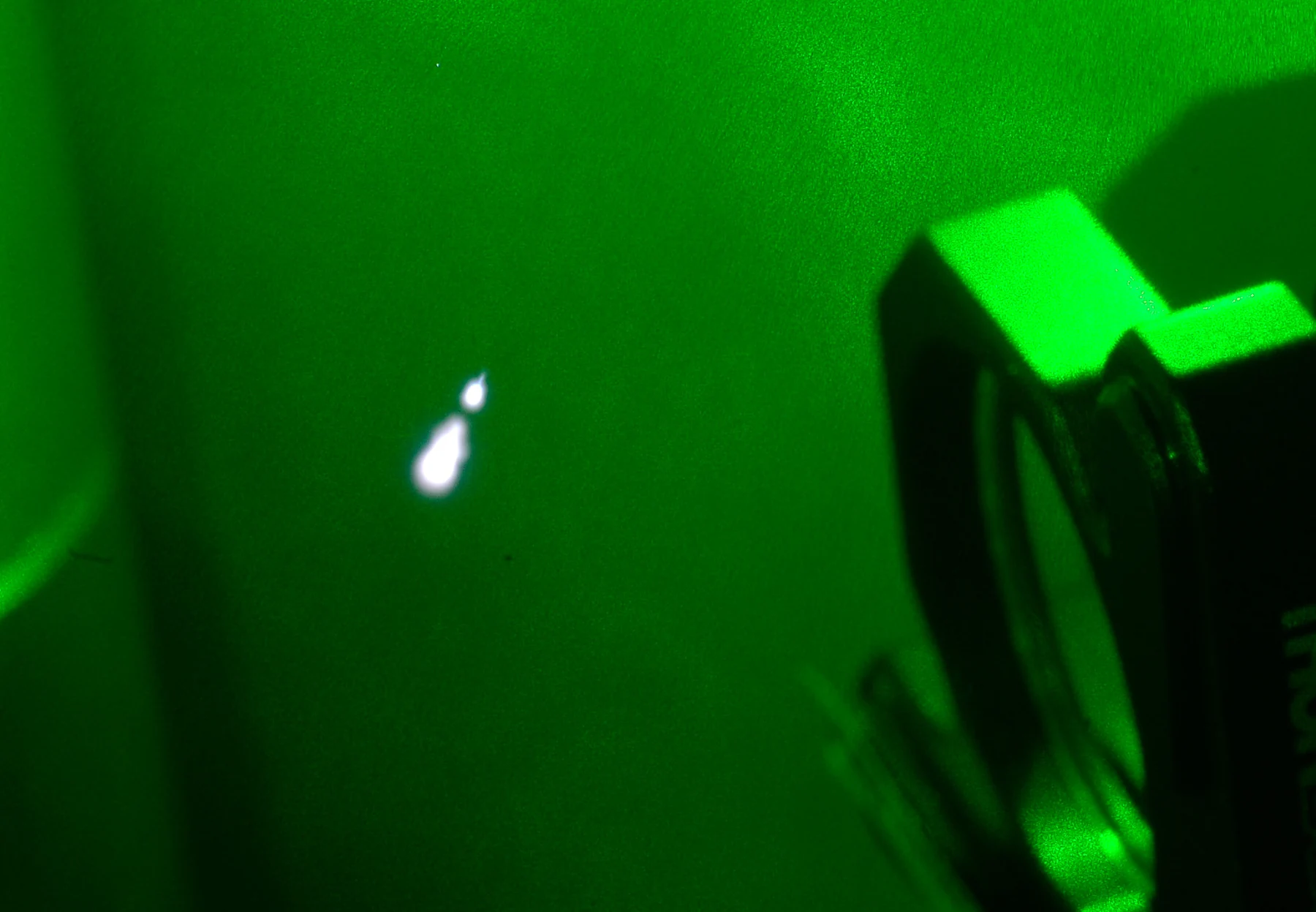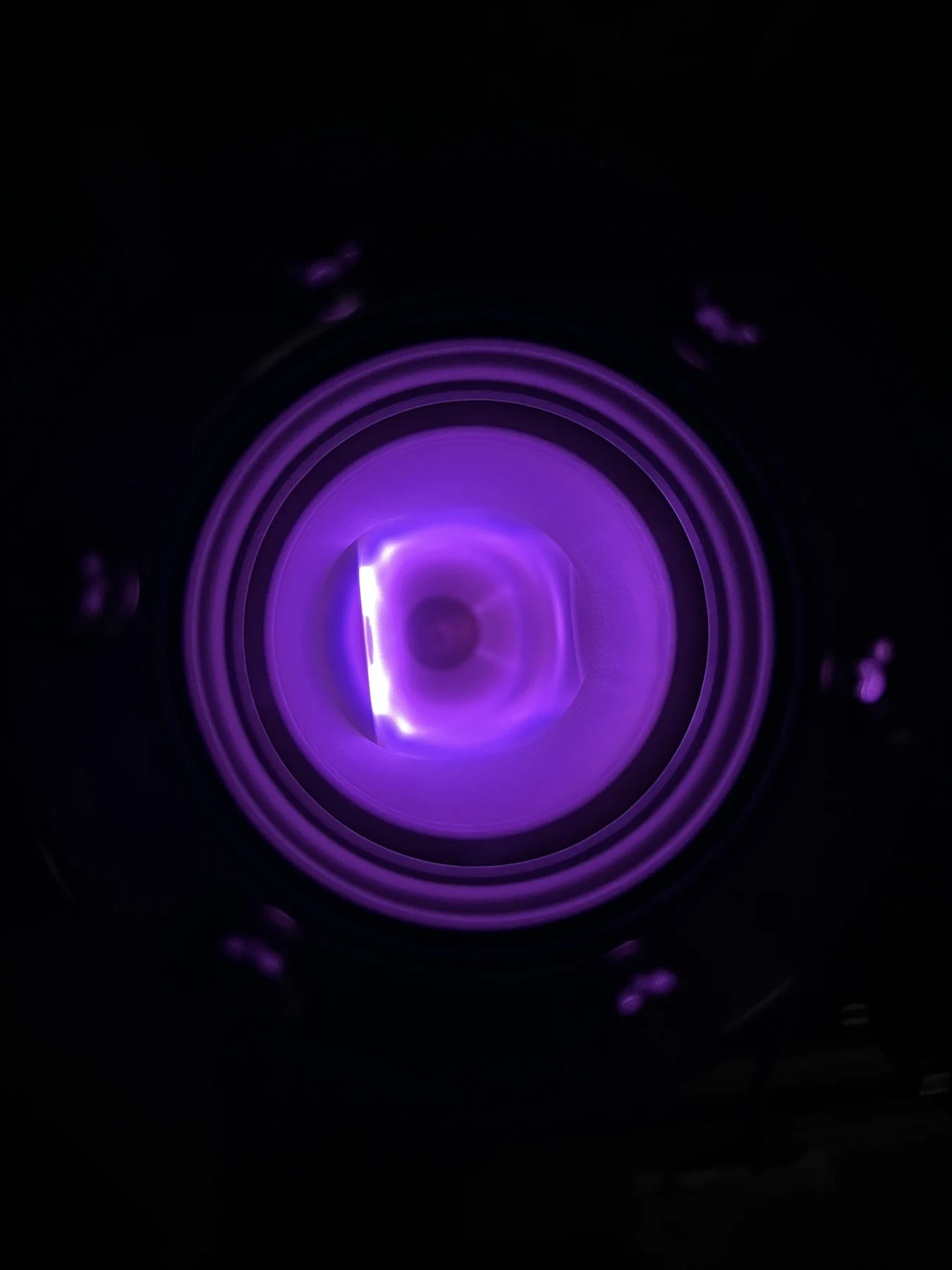
What changes when a gas stops behaving like an ordinary gas? The key is not simply that it glows or gets hot: some of its electrons have been separated from atoms or molecules, creating charged particles that can move and respond to fields. This partly ionized state is called plasma. Its unusual electrical behavior explains why the same broad category includes lightning in the sky and a sterilization process inside a sealed chamber.
A gas with mobile charges
In an ordinary gas, atoms or molecules are overall electrically neutral: each atom’s positive nucleus is balanced by its negative electrons. Add enough energy and some electrons can break free. The remaining atoms or molecules become positive ions, while the freed electrons carry negative charge. A plasma contains both, along with neutral particles, so it is only partly ionized in many familiar examples. Princeton Plasma Physics Laboratory describes plasma as a state of matter alongside solids, liquids, and gases [1].
Imagine a crowd of neutral people in a room, each carrying equal positive and negative tokens that stay together. Now let some tokens separate and move independently. The crowd can respond to an external electrical push in a way it could not when every pair stayed bound. In a plasma, mobile electrons and ions allow electric current to flow; the charged mixture also reacts to electric and magnetic fields [1].
How a gas crosses the boundary
Ionization is the process of removing electrons from atoms or molecules. Heating can supply the energy: collisions become energetic enough to free electrons. But “plasma” does not mean every particle is stripped bare, nor does the word specify one temperature. It describes the presence of free charge carriers and their collective response. A glowing appearance may accompany some plasmas, but glow alone is not the definition.
Lightning gives a dramatic natural example: electrical conditions in the atmosphere produce a conducting path through air. Fluorescent lamps also contain plasma, while stars are vast hot plasmas in which matter is strongly ionized [1]. These examples differ enormously in scale, temperature, and how they are sustained. The useful comparison is their shared charged behavior, not a claim that their environments are alike.
A controlled plasma in sterilization
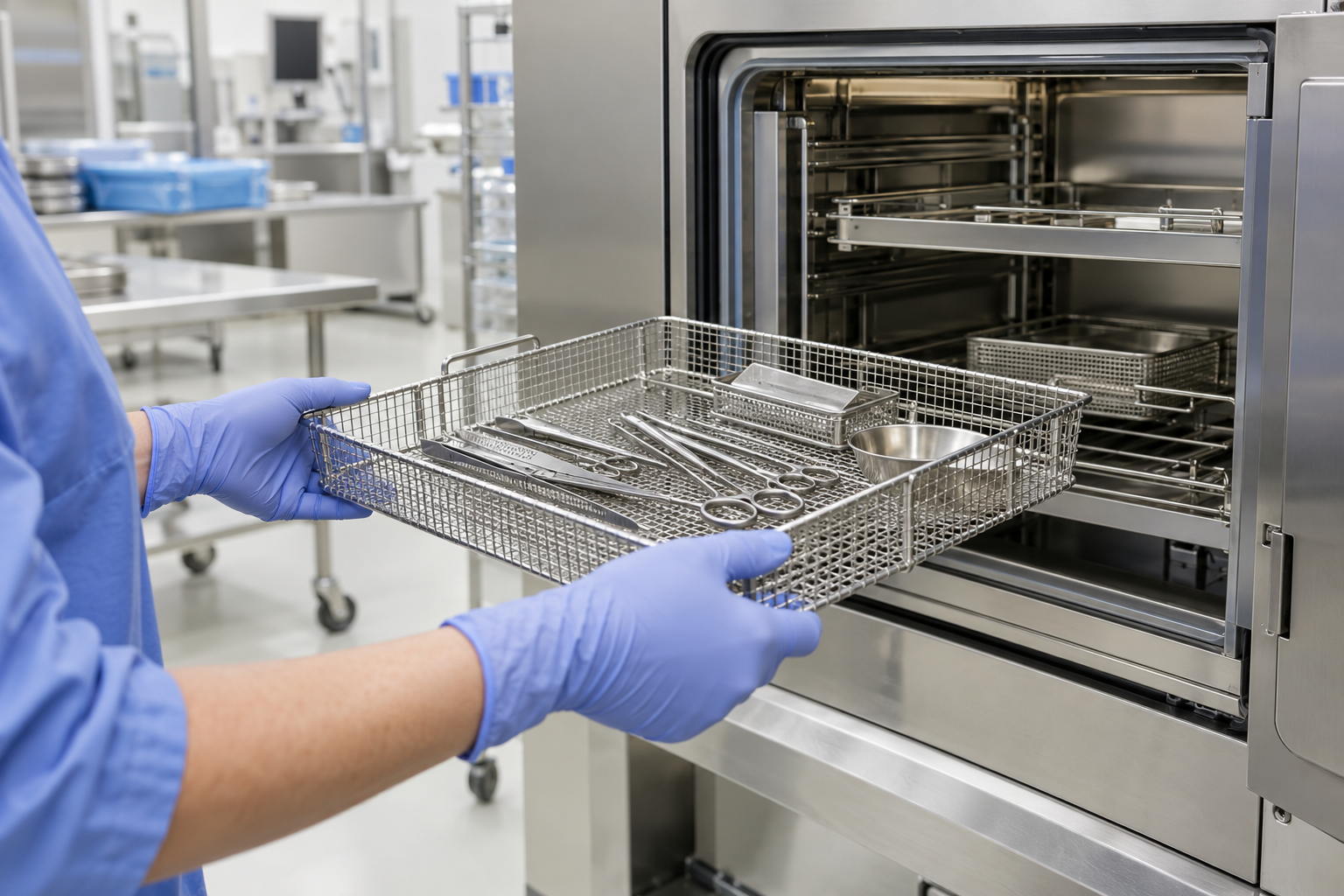
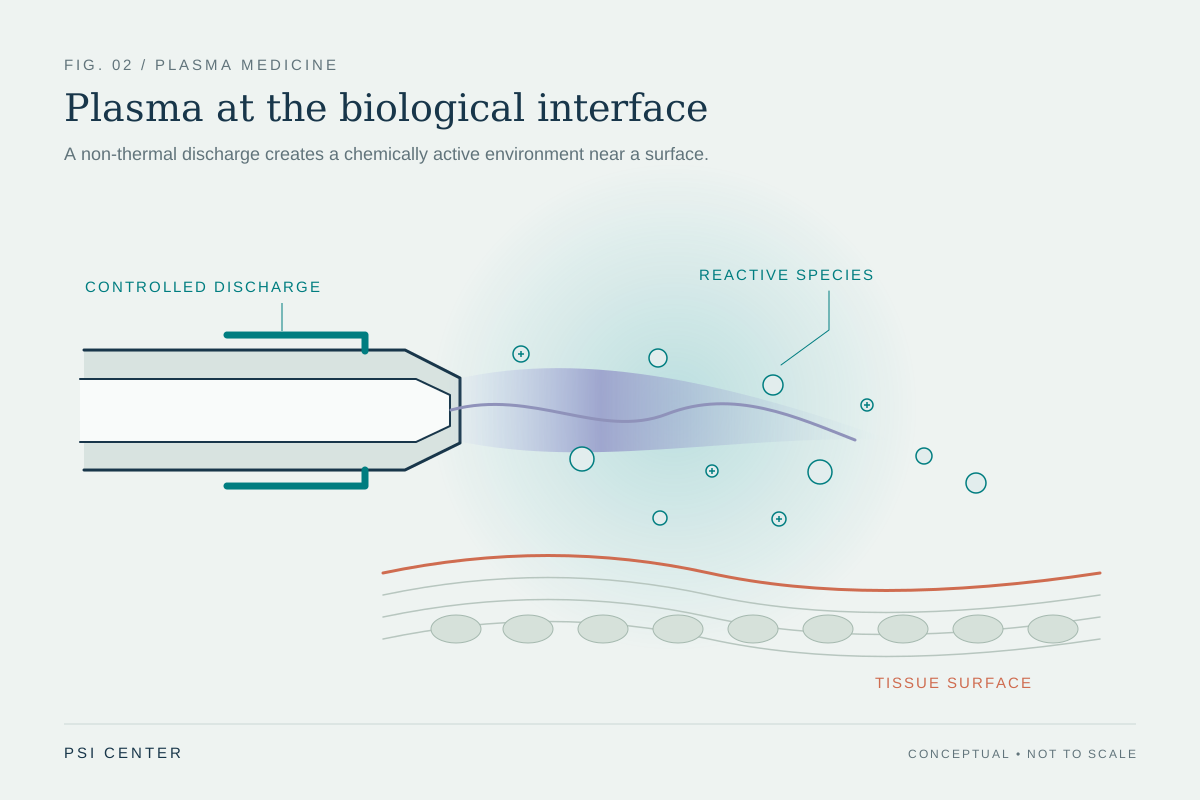
A hospital sterilizer can create plasma in a very different setting. The CDC describes hydrogen peroxide gas plasma equipment that operates in an enclosed chamber under deep vacuum. Radio-frequency or microwave energy excites gas molecules and produces charged particles and reactive species, including free radicals—atoms or molecules with an unpaired electron [2].
In this process, hydrogen peroxide vapor reaches device surfaces, and a plasma stage generates reactive species that help disrupt essential components of microorganisms. The CDC notes that the method is used for some heat- and moisture-sensitive medical devices; it is a controlled equipment-sterilization process, with effectiveness affected by factors such as narrow channels and material residues [2]. It does not follow that every plasma has the same chemistry or purpose.
One name, different environments
The word plasma can suggest the pale liquid part of blood, but physics uses it for an ionized gas. Even within that physics meaning, a fusion plasma and a sterilizer’s low-temperature gas plasma are not interchangeable. Fusion research confines extremely hot charged matter to bring atomic nuclei close enough to fuse; a medical-device sterilizer instead uses hydrogen peroxide chemistry and reactive particles to inactivate microbes [1] [2].
A useful mental test is to ask what is moving freely and what fields can do to it. If electrons and ions move through a gas, electric and magnetic forces can organize its behavior. That question identifies the physical feature behind the label, while the gas composition, energy input, temperature, and setting tell us what a particular plasma can actually do.
Explore the physics: an explanatory diagram
Sources & further reading
- About Plasmas and Fusion Princeton Plasma Physics Laboratory
- Hydrogen Peroxide Gas Plasma CDC
Prepared for the independent PSI Center reading library. About edition dates and source checking.
This explainer describes scientific principles. It does not assess individual treatment choices.