Why can a proton beam deposit much of its energy near a chosen depth and then stop? A proton entering tissue slows as it interacts with matter. Near the end of its range, it releases energy especially densely, forming the Bragg peak. This physical pattern gives proton therapy a potential advantage in shaping dose, while also making accurate range estimates essential.
A charged particle spends energy on the way
A proton is a positively charged particle. As it travels through tissue, it interacts electromagnetically with electrons and nuclei in atoms. These interactions transfer energy from the moving proton to the material, gradually slowing the particle. It does not carve a clean tunnel; its path is affected by many small interactions, and energy is deposited along the way.
The rate of energy loss is not constant. A proton generally deposits energy more densely as it slows, reaching a pronounced rise near the end of its path. This concentration is called the Bragg peak. Past that depth, the proton stops, so there is little proton dose beyond its range compared with the continuing exit dose of a photon beam. The peak is a physical distribution, not a guarantee that surrounding tissue receives no radiation.
Choosing an energy chooses a depth
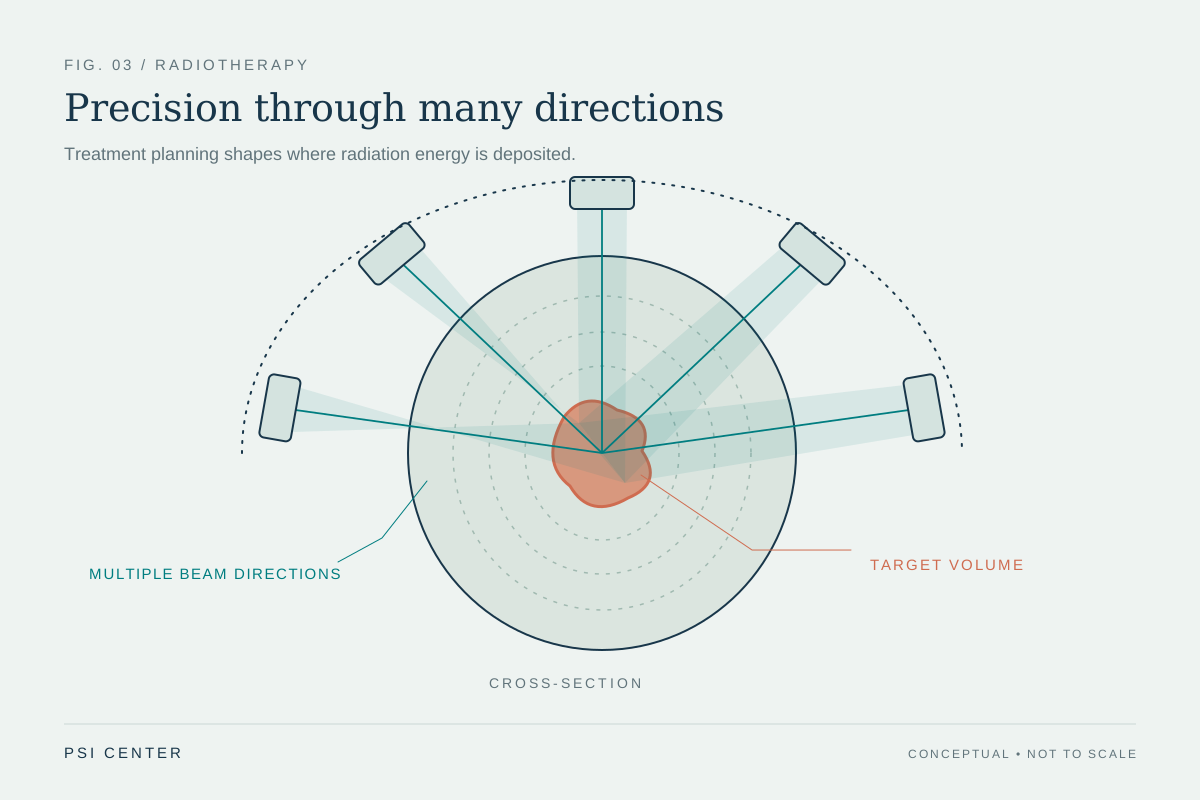
Consider a target embedded several centimeters beneath the skin. A proton beam’s starting energy influences how far it penetrates before stopping. By selecting energies and combining beams, treatment planners can position high-dose regions to overlap a tumor. The beam path still traverses tissue before reaching the target, but the particle’s stopping behavior can reduce dose delivered beyond it. The National Cancer Institute describes proton beams as stopping once they reach the tumor, in contrast with photon beams that continue through normal tissue beyond it [1].
Real tumors have thickness, not a single depth, so treatment planning may combine multiple proton energies to spread the high-dose region across the target. This is often described as a spread-out Bragg peak. Imaging and computer calculations help estimate the target’s position and shape and design a treatment path [1]. The central challenge is matching the depth distribution to anatomy that can vary from one patient and treatment moment to another.
Why the edge is useful and delicate
The steep falloff after the peak can be useful near sensitive structures: if the beam stops in the intended region, less dose may reach tissue farther along the path. But a sharp edge also makes errors consequential. If the actual tissue density or target position differs from the plan, the stopping point may shift. A beam that ends short can underdose part of the target; one that travels farther can expose tissue beyond it.
Computational models simulate complex systems using mathematical and physical variables, generating predictions under specified conditions [2]. For radiation planning, calculations estimate how particles move and deposit energy through an imaged body. Such models are valuable because direct trial and error in a person is not an option. Their predictions remain dependent on input images, assumptions about tissue, and the accuracy of the treatment setup.
A physical advantage is not a universal outcome
The Bragg peak describes where energy deposition rises and falls; it does not alone determine whether proton therapy improves a patient’s outcome. Clinical effects depend on cancer type, anatomy, treatment planning, and comparison with alternatives. The National Cancer Institute notes that proton therapy may reduce the amount of normal tissue exposed, while clinical trials compare proton and photon approaches [1]. Physical dose shaping is one part of the evidence needed to judge treatment.
A helpful image is a moving vehicle that brakes more strongly near a planned stopping point: energy is still spent along the route, but the final region receives a concentrated deposit and the vehicle does not continue past the stop. The analogy has limits because a proton beam consists of many particles with a spread of ranges, and tissue is not uniform. Still, it captures why the end of a proton’s range is both its key opportunity and its precision challenge.
Explore the physics: an explanatory diagram
Sources & further reading
- External Beam Radiation Therapy National Cancer Institute
- Computational Modeling NIBIB
Prepared for the independent PSI Center reading library. About edition dates and source checking.
This explainer describes scientific principles. It does not assess individual treatment choices.