What makes one beam of light a surgical tool and another a pointer? A laser concentrates light into a narrow beam with a specific wavelength, but the label alone does not tell you what happens in tissue. To understand a medical laser description, trace the path from the device’s light to its target, then ask what procedure is intended and what evidence supports that use. The physics explains how energy can be focused; clinical evidence determines what that focus accomplishes for patients.
Start with the light, not the promise
Laser is short for light amplification by the stimulated emission of radiation. Unlike ordinary light, which contains a mixture of wavelengths and spreads in many directions, laser light is amplified at a specific wavelength and can be directed as a narrow beam. Concentrating energy into a small area can create high intensity, which is why lasers can cut or alter materials and tissue [1].
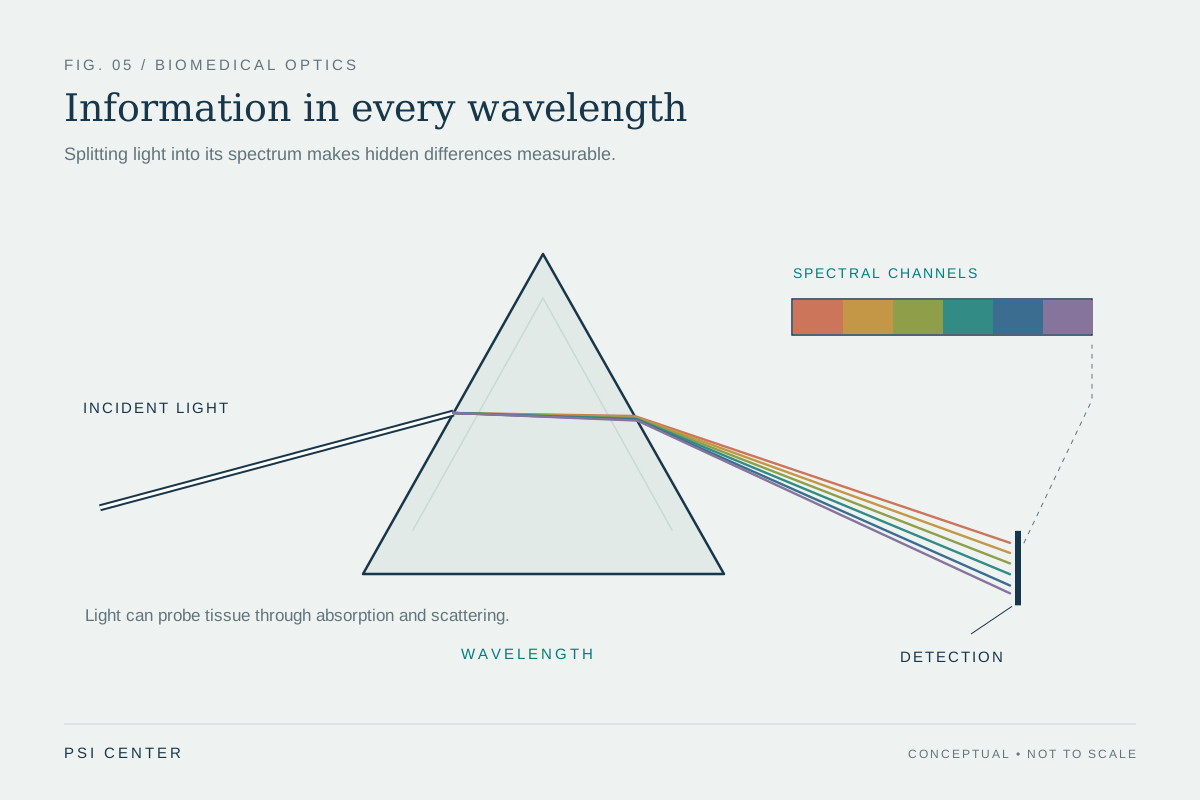
Wavelength matters because different tissues absorb different colors of light. A medical description should identify the target and the intended interaction rather than rely on the word “precision.” A beam can be focused precisely yet still have different effects depending on where it lands, how it is delivered, and how tissue absorbs it.
Follow the beam to the tissue
Some cancer laser procedures treat surface tissue; others reach internal sites through an endoscope, a narrow lighted tube. Optical fibers—thin strands that transmit light—can carry the beam through a flexible scope to a treatment site. Carbon dioxide and argon lasers can cut the skin surface without penetrating deeply, while Nd:YAG lasers are more often used through endoscopes for internal organs. Argon lasers also have a role in photodynamic therapy, which uses light as part of a treatment process [2].
These examples show why a device name is not enough to understand a procedure. The same general technology can serve different targets and routes. A description should make clear whether a laser cuts, destroys, or otherwise acts on tissue and how it reaches the intended location. Lasers may also seal blood vessels during surgery or be used to ease a blockage, which is a distinct goal from removing a tumor as treatment [2].
Separate tissue effects from patient outcomes
When a laser cuts tissue, it can seal the cut and reduce bleeding. The National Cancer Institute describes possible advantages such as less damage to normal tissue, pain, swelling, and scarring in some surgical contexts, while also noting drawbacks: specialized equipment and training are needed, treatment can be expensive, and effects may not last, so repetition can be necessary [2]. Those tradeoffs belong in any fair account of a procedure.
A physical explanation—light absorbed by tissue, followed by heating or cutting—does not prove that a laser is better for every patient or condition. Ask what outcome was measured and whether the comparison was with another approach. A shorter procedure, less bleeding, and long-term disease control are different endpoints. Evidence for one should not quietly stand in for evidence about the others.
Read safety and regulation as separate questions
Laser products are grouped into hazard classes based on their potential to cause injury. Higher classes generally carry greater risk if used improperly; Class IV products can present immediate hazards to skin and eyes from direct or reflected beams, and may present a fire hazard. Medical lasers are among the products that require appropriate safety controls and risk communication [1]. Safety classification describes hazards, not how well a particular treatment works.
Medical laser products must meet radiation safety requirements, and products used for medical applications must also comply with medical-device regulations [1]. That regulatory distinction helps frame the description: ask what kind of product it is, what medical procedure it is designed for, and what clinical evidence supports that procedure. A laser’s capacity to focus light is a physical capability, not a universal promise of benefit.
Explore the physics: an explanatory diagram
Sources & further reading
- Laser Products and Instruments FDA
- Lasers in Cancer Treatment National Cancer Institute
Prepared for the independent PSI Center reading library. About edition dates and source checking.
This explainer describes scientific principles. It does not assess individual treatment choices.