How does a radioactive medicine reach one kind of cell among the billions circulating through the body? It does not steer like a tiny vehicle. Instead, a molecule attached to the radioactive atom takes advantage of chemistry and biology: it may bind a receptor, mimic a nutrient, or follow a natural pathway. The target helps determine where the medicine accumulates, while the radioactive atom supplies a signal or therapeutic energy.
A carrier and a radioactive payload
A radiopharmaceutical typically combines a radioactive atom with a carrier molecule. In engineered treatments, a linker can join the two. The carrier supplies the biological address: it recognizes or accumulates near a molecule or tissue of interest. The radioactive component supplies the detectable emissions or the energy that can damage nearby cells [1].
The match is not a lock-and-key guarantee that every molecule reaches only the intended cells. The medicine travels through blood or another route, encounters many tissues, and is eventually cleared or decays. Its distribution reflects blood supply, the availability of the target, binding strength, and the body's handling of the compound. A useful target is one that is sufficiently present in the disease tissue and accessible to the carrier.
Natural routes and engineered recognition
Some radiopharmaceuticals exploit a body's existing chemistry. Radioactive iodine, for instance, is taken up by thyroid cells because the thyroid naturally uses iodine. Radium can enter areas of active bone turnover partly because it behaves in ways resembling calcium. These examples show that targeting can arise from a tissue's normal biology, rather than from a custom-designed recognition molecule [1].
Other agents are engineered to recognize a particular surface molecule. A carrier might be a small molecule, peptide, or antibody-like structure that binds a target. After administration, circulation gives it opportunities to encounter target-bearing cells. Binding increases local concentration, but unbound material can still travel elsewhere. That is why “targeted” means guided by a biological preference, not confined with perfect precision.
From molecular location to image
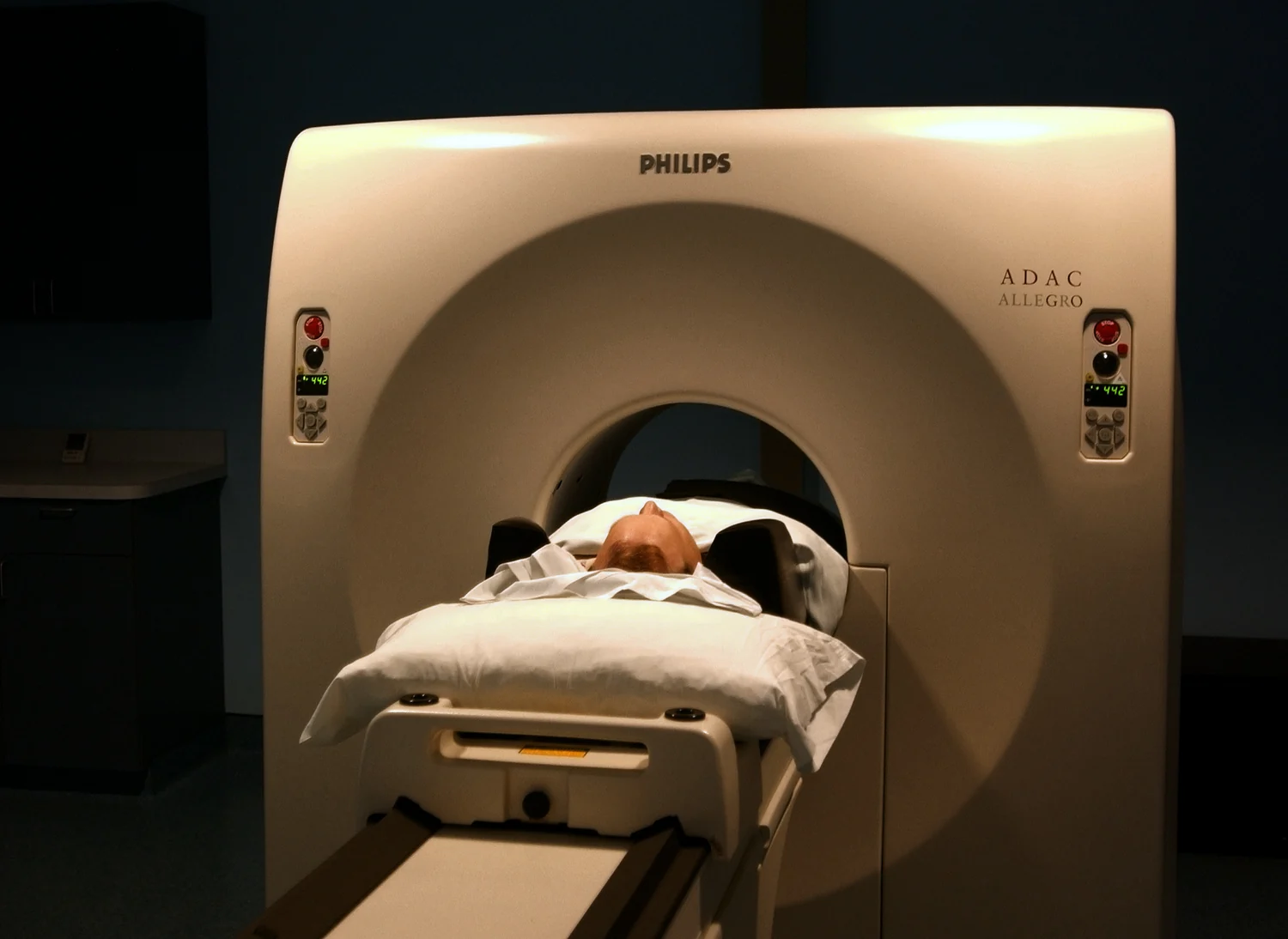
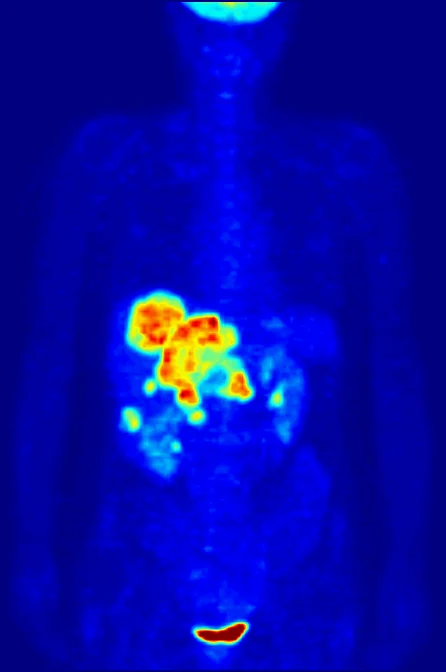
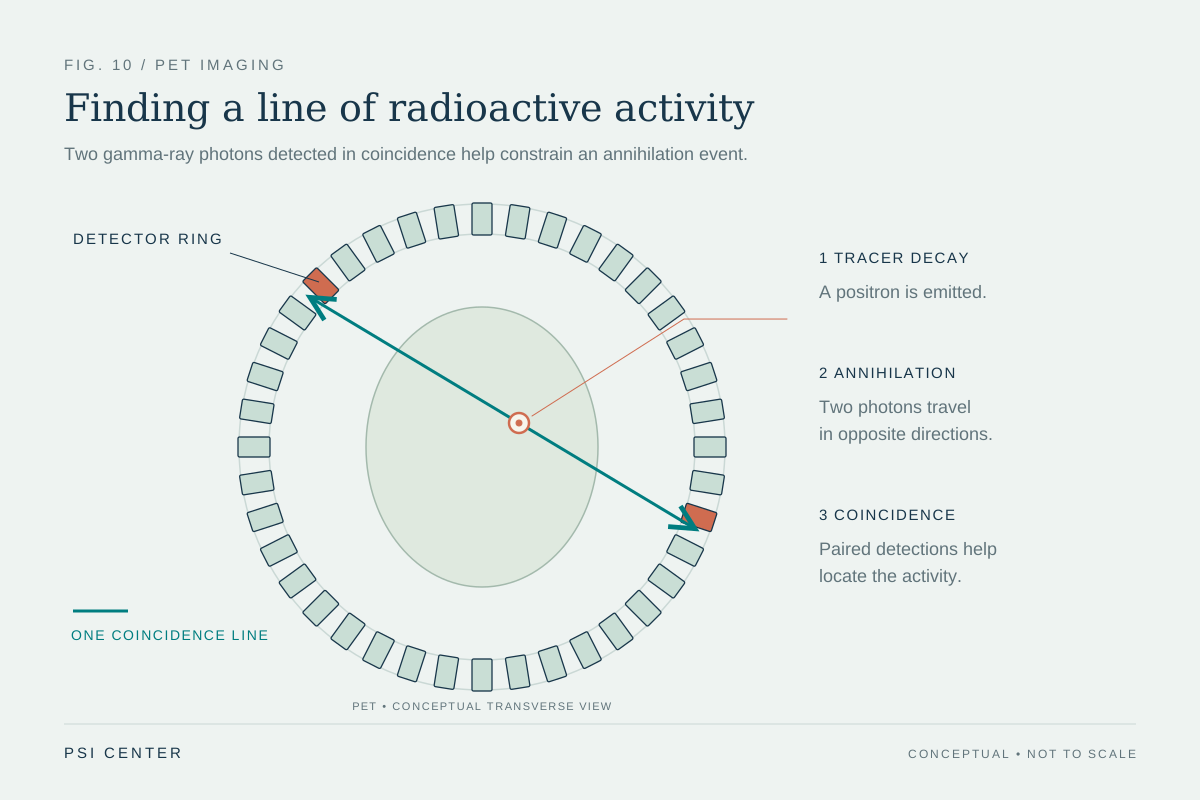
For imaging, the radioactive atom is chosen so its emissions can be detected outside the body. A PET tracer emits positrons; when a positron meets an electron, they annihilate and produce two gamma photons that travel in nearly opposite directions. Detectors register coincident photons, and a computer uses their paths to build a map of tracer distribution [2]. SPECT instead detects gamma rays emitted directly by its tracers.
The resulting image maps where the tracer went, which can reveal a biological process or target expression. It does not photograph cancer cells directly. A PET signal may indicate uptake of a glucose-like tracer in active tissue, for example, but interpretation depends on the tracer and the clinical context. Imaging versions of a compound can sometimes help assess whether a related treatment molecule is likely to reach its target, though the imaging result does not guarantee a therapeutic response.
When the signal becomes treatment
Therapeutic radiopharmaceuticals use emissions that deliver damaging energy to cells. Radiation can injure DNA, and a cell that cannot repair severe damage may die. Depending on the isotope and its emitted particles, energy can affect the cell carrying the agent and nearby cells as well. This local reach can be useful when not every cancer cell displays the target, but it also means nearby healthy tissue may receive radiation.
The same general idea underlies radiotheranostics: a diagnostic compound and a therapeutic partner share a target, while their radioactive atoms serve different roles [2]. Treatment requires more than identifying a molecular address. Clinicians and medical physicists must consider distribution and absorbed dose, including exposure to organs that collect the compound. Targeting can make radiation more selective than an external beam in some situations, but it does not remove the need to understand where the medicine travels or what the radiation can affect.
Explore the physics: an explanatory diagram
Sources & further reading
- Radiopharmaceuticals: Radiation Therapy Enters the Molecular Age National Cancer Institute
- Nuclear Medicine NIBIB
Prepared for the independent PSI Center reading library. About edition dates and source checking.
This explainer describes scientific principles. It does not assess individual treatment choices.