How can the word “plasma” describe both a fusion experiment hotter than the Sun’s core and a device being studied for wound care? Plasma is a state of matter, not a single temperature or medical treatment. Its properties depend on how it is produced and used. Fusion research and plasma medicine therefore share basic physics, while their operating conditions and goals are sharply different.
A gas with charged particles
A plasma forms when some electrons are freed from atoms or molecules, leaving a mixture of electrons, ions, and neutral particles. Because it contains charged particles, it can conduct electric current and respond to electric and magnetic fields. Lightning is a familiar natural plasma; fluorescent lamps and stars provide very different examples. [1]
In fusion research, plasma is heated to extremely high temperatures so atomic nuclei can collide and fuse. Magnetic fields or lasers help confine it in a small region. The objective is to create conditions for fusion energy, not to expose living tissue to that hot material. [1]
Cold atmospheric plasma is a different regime
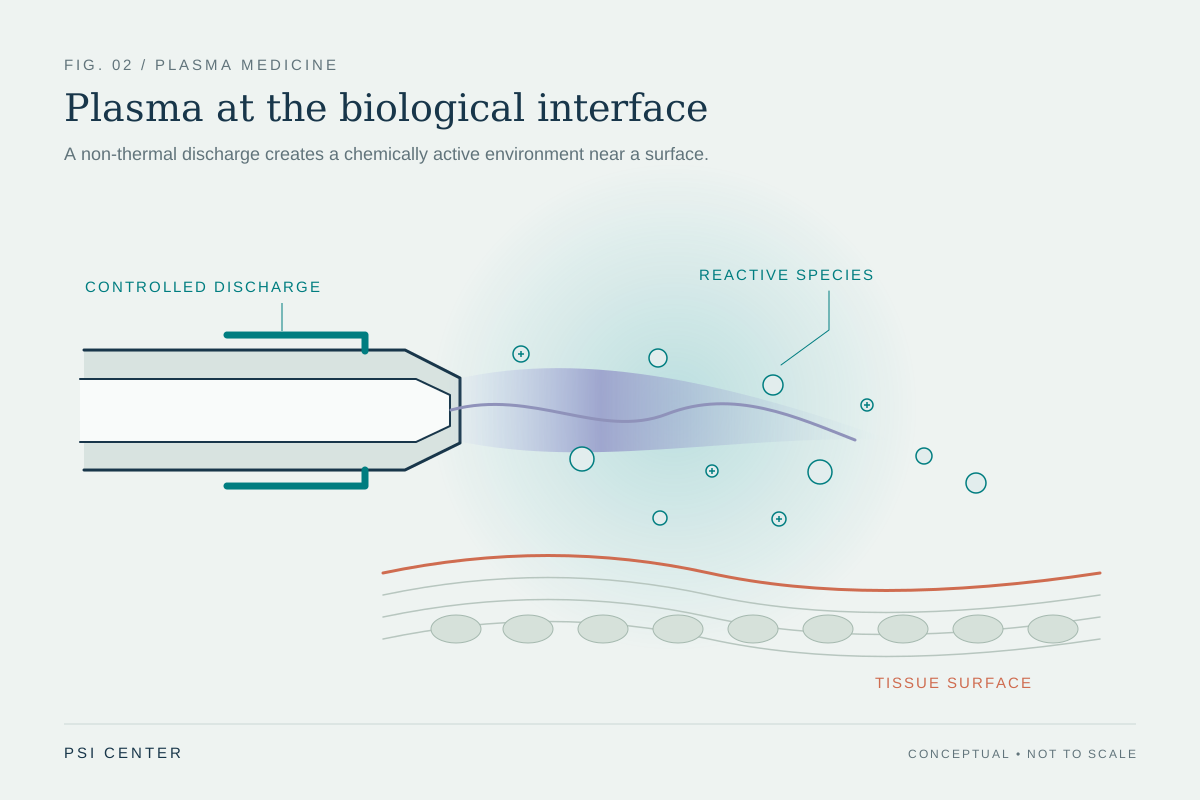
Cold atmospheric pressure plasma (CAP) is generated near ordinary atmospheric pressure and is used in research on surfaces and living tissue. “Cold” distinguishes its overall treatment conditions from the extreme heat of fusion plasmas; it does not mean the gas has no reactive activity. Medical interest includes antisepsis and possible effects on wound processes. [2]
The useful comparison is a kitchen flame versus a charged gas produced in a controlled device: sharing a broad category does not make their temperature, chemistry, or purpose interchangeable. In particular, CAP is not the same as argon plasma coagulation, which heats and coagulates tissue, or plasma used to sterilize equipment. Those applications involve different processes and aims.
A proposed biological pathway is not a proven benefit
CAP can produce reactive particles and molecules that interact with a surface. Researchers study whether these interactions can reduce microbes or influence cells involved in healing. A plausible mechanism, or a laboratory result, does not by itself show that a treatment improves outcomes for patients. Clinical evidence must be assessed for the condition, device, comparison, and quality of the trials.
Evidence for chronic wound use remains mixed. The 2023 International Working Group on the Diabetic Foot guideline recommends against other gases, including CAP, for healing diabetes-related foot ulcers, citing low-certainty evidence with substantial risk of bias. That recommendation is specific to this clinical question and underscores why promising mechanisms should not be mistaken for established routine care. [3]
Research aims need careful boundaries
A research program may ask whether CAP can disinfect a wound surface, influence tissue repair, or work alongside existing care. Those are distinct questions. A finding about one does not automatically establish the others, and results from one wound type or device cannot simply be generalized to every setting. The institute source describes clinical studies and potential applications, but such descriptions do not settle the strength of evidence across conditions. [2]
The distance from fusion to medicine is therefore conceptual: both fields study ionized gases, but they use different plasma conditions to answer different questions. In medicine, the relevant test is whether a particular device and protocol produce a reliable clinical benefit with acceptable risks. Keeping that distinction clear lets plasma physics inspire new experiments without turning a research frontier into an unsupported treatment claim. [1]
Explore the physics: an explanatory diagram
Sources & further reading
- About Plasmas and Fusion Princeton Plasma Physics Laboratory
- Wound Healing and Antisepsis Leibniz Institute for Plasma Science and Technology
- Guidelines on Interventions to Enhance Healing of Foot Ulcers: 2023 Update International Working Group on the Diabetic Foot
Prepared for the independent PSI Center reading library. About edition dates and source checking.
This explainer describes scientific principles. It does not assess individual treatment choices.