How can a thin wall let unwanted molecules escape blood while keeping blood itself safely contained? The answer is a membrane with openings that permit some kinds of motion and hinder others. In hemodialysis, that selective boundary sits between blood and a cleansing solution, making the membrane’s structure a practical example of a broader materials challenge: allowing enough through, but not too much.
A wall that sorts by passage
A membrane is a boundary separating two regions. Permeability describes how readily substances can cross it; selectivity describes which substances are favored or blocked. These properties are related but not interchangeable. A highly open barrier may allow rapid movement while losing useful components, whereas an extremely restrictive one may protect everything yet also trap the material meant to leave.
Imagine a screen with openings. Large objects cannot pass through small openings, but size is only part of the story in real materials. Molecules move through water-filled pathways, and their passage depends on size, concentration differences, electrical charge, and interactions with the material. Engineers must choose a structure that makes desired routes available without making every route equally easy.
Dialysis as a working example
In hemodialysis, blood flows inside many thin hollow fibers in a dialyzer while dialysis solution travels outside them in the opposite direction. Dissolved waste products move from blood into the solution across the fiber walls; filtered blood stays inside and returns to the body. The machine also controls blood flow and fluid removal. This is not a sieve that simply catches particles: molecules diffuse across a selective barrier because their concentrations differ on the two sides. [1]
The solution’s composition matters alongside the membrane. NIDDK explains that it contains water and added chemicals, and clinicians can adjust its balance to help remove wastes, salts, and fluid while addressing mineral levels. The system works through coordinated choices: fiber geometry provides a large exchange area, the membrane permits useful molecular movement, and the solution maintains conditions that favor transfer. [1]
Why faster is not always better
Permeability often creates a tempting design target: make transport faster. But if a membrane is too permeable, it can allow substances that should remain in blood to cross. If it is too selective in the wrong way, wastes may move too slowly. The desired balance depends on what is being separated, the scale of the molecules, and the conditions on each side. A filter for one task is not automatically suitable for another.
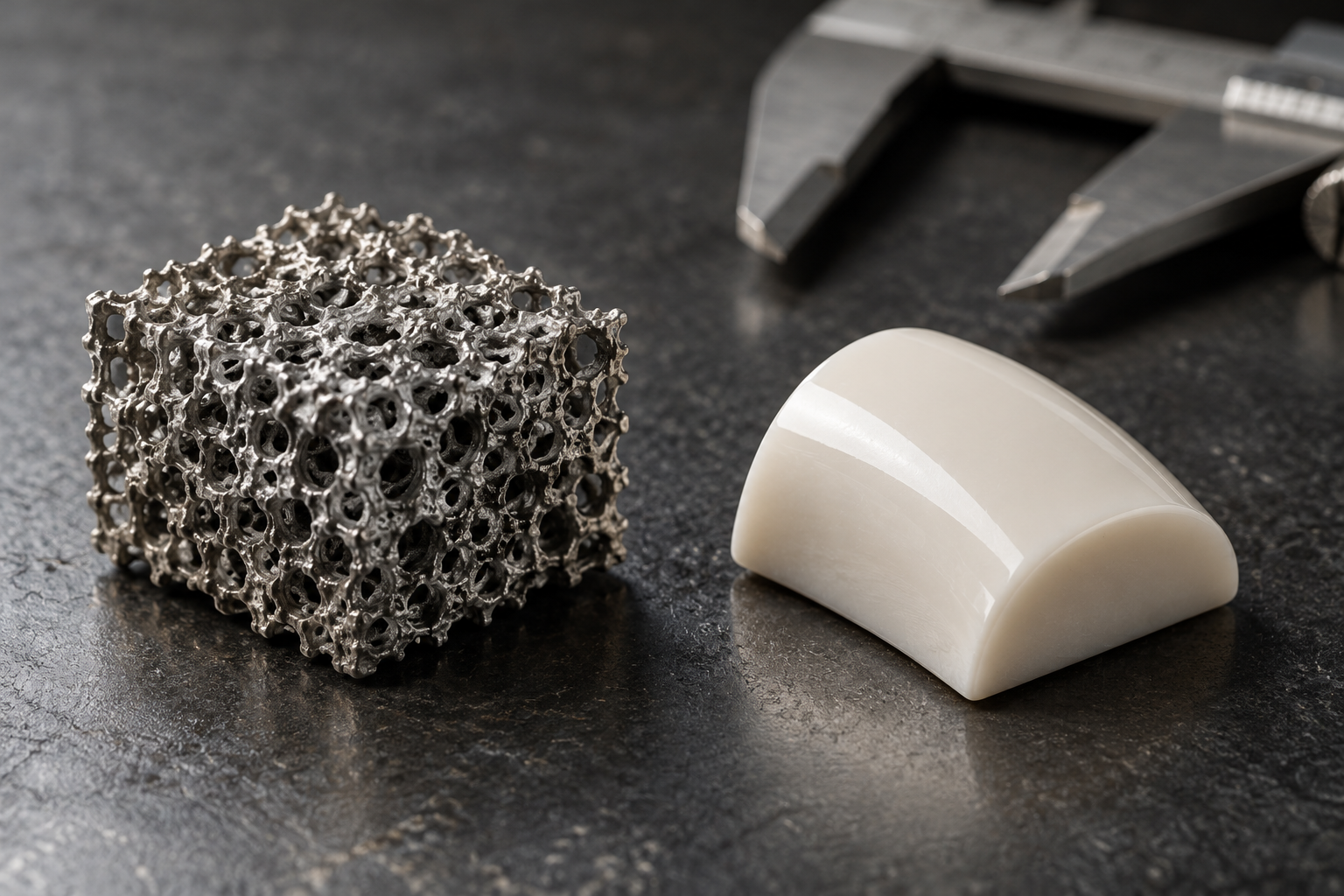
This tradeoff appears in many biomaterials. A coating on an implant may need to admit water and small molecules while resisting corrosion; a drug carrier may need to protect its contents during circulation and then release them at an intended place or in response to a stimulus. Biomaterials can be formed as films, fibers, foams, coatings, and other structures, each shaping the contact between material and body. [2]
The body is part of the design
A material used in medicine must also interact acceptably with living tissue. The body may respond to a foreign object by degrading it or surrounding it with scar tissue, a response that can impair a device. Some designs use biologically inert materials; others imitate aspects of the extracellular matrix, the natural scaffold around cells, to encourage integration. This means the best membrane is not defined by transport alone. It must work within a biological setting over time. [2]
The dialyzer illustrates the central engineering question clearly: what should cross, how quickly, and under what conditions? A membrane is successful when its permeability supports the needed exchange and its selectivity preserves the boundary’s purpose. That same reasoning guides biomaterial design elsewhere, though the right balance changes with each application and cannot be assumed from a material’s name alone.
Sources & further reading
- Hemodialysis NIDDK
- Biomaterial Technologies NIBIB
Prepared for the independent PSI Center reading library. About edition dates and source checking.
This explainer describes scientific principles. It does not assess individual treatment choices.