When a hand feels weak, how can a test help determine whether the problem lies in a muscle or in the nerve that activates it? Electromyography, or EMG, records electrical activity associated with muscle at rest and during contraction. A companion nerve conduction test measures how quickly and strongly electrical signals travel along a nerve. These are related but distinct measurements: one listens to muscle response, while the other examines the route that helps trigger it.
Muscle activity is electrical
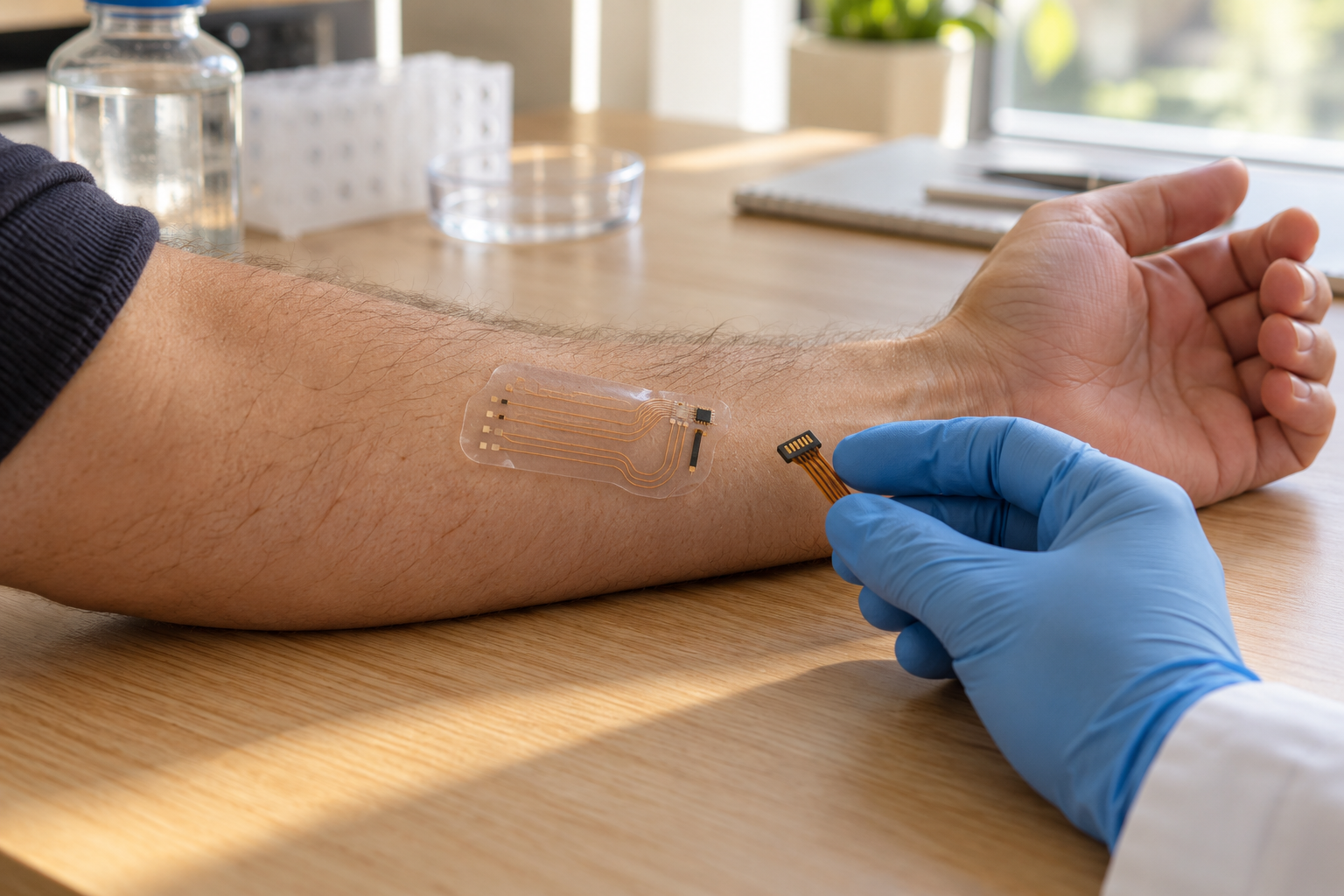
Muscle fibers respond to signals from nerves with electrical changes across their membranes. An EMG uses a thin needle electrode placed in a muscle to pick up electrical activity. The signal can be displayed on a monitor and heard through a speaker. A clinician may ask for a contraction, such as bending the arm, to compare activity when the muscle is quiet and when it is working. [1]
At rest, a healthy relaxed muscle ordinarily shows very little electrical activity in this test. As the muscle contracts more strongly, the recorded activity increases and forms patterns. The instrument does not directly measure strength as a simple number, nor does it photograph the muscle. It records electrical signals near the electrode, which are interpreted alongside the examination and other information.
Two tests, two links in a chain
A nerve conduction velocity test is commonly performed during the same visit as EMG. It measures how fast and how strongly electrical signals move through a nerve. Think of the nerve as a communication cable and the muscle as a receiver that responds. Nerve conduction testing examines signal travel along the cable; needle EMG samples the receiving muscle’s electrical response. Looking at both can help distinguish a problem affecting nerve input from one involving muscle or the broader nervous system. [1]
That distinction matters because similar symptoms can arise through different mechanisms. Weakness might follow reduced stimulation of a muscle by its nerve, or it might come from a muscle disorder. EMG can help sort these possibilities by looking at electrical activity at rest and during activation. It does not by itself name the cause of every symptom, and an abnormal pattern can have multiple possible explanations.
What the signal can reveal
A clinician may use EMG when someone has weakness, pain, or unusual sensation. The test can help evaluate patterns associated with conditions affecting nerves or muscles, including peripheral nerve problems and some muscle diseases. The recording provides evidence about how a muscle responds under the test conditions; it is not a complete inventory of every nerve or muscle in the body. Choosing which muscles to sample depends on the clinical question. [1]
The signal also depends on the setup and circumstances. For example, body temperature can affect nerve conduction results, so a person who arrives from very cold conditions may be asked to wait in a warm room. Needle placement and the requested contraction influence what is recorded as well. These details illustrate a broader point about sensors: measurements are produced by an interaction between the body, the instrument, and the testing procedure. [1]
From measurement to movement technology
Electrical activity in muscle can also serve as information for a device. In research on bionic systems, sensors can measure electrical signals from a person’s residual muscle and use them to support control of a prosthetic device. NIBIB describes a prosthetic ankle that uses signals from residual muscle to help a user maintain control of posture and balance. This is a different use from a diagnostic EMG: a sensor becomes part of a control loop rather than a test interpreted to investigate symptoms. [2]
In a control loop, muscle activity is detected, translated into a signal, and used to influence device behavior. The same basic idea—that biological electrical activity can carry information—underlies both measurement and control, but the applications are not interchangeable. A clinic EMG is not itself a prosthetic controller, and a device’s ability to use a signal does not mean it diagnoses a disorder. Separating measurement from interpretation, and interpretation from action, helps explain what EMG reveals and what it leaves open. [2]
Sources & further reading
- Electromyography MedlinePlus
- Robotic and Bionic Medical Devices NIBIB
Prepared for the independent PSI Center reading library. About edition dates and source checking.
This explainer describes scientific principles. It does not assess individual treatment choices.