What has to happen to an ordinary gas before electricity can steer it? The key change is that some electrons become free to move. The gas then contains charged particles alongside atoms or molecules that remain neutral. This mixture, called plasma, behaves differently from a gas made entirely of neutral particles, even when it looks like a faint glow or is hidden inside a device.
A charge ledger for one atom
An atom is built around a compact nucleus containing positively charged protons and, in most cases, uncharged neutrons. Negatively charged electrons occupy the space around it. In a neutral atom, the positive and negative charges balance: the number of electrons matches the number of protons. The word “neutral” describes the total charge, not an absence of charged parts.
If an electron is removed, the atom is left with more positive charge than negative charge. It is now a positive ion. An atom or molecule that gains an extra electron becomes a negative ion. These changes can happen when particles collide with enough energy to dislodge an electron. The ionization need not affect every atom in a gas; a plasma can be only partly ionized, with ions, free electrons, and neutral particles coexisting [1].
Why a few free electrons matter
Picture a row of neutral atoms with one electron knocked loose. The free electron can move through the gas; the positive ion it left behind generally moves much more slowly. Apply an electric field, and charged particles feel forces: electrons move one way, positive ions the other. That directed motion is an electric current. A gas of neutral atoms alone does not respond in this way as readily, which is why even partial ionization changes the gas’s electrical behavior [1].
The same charge separation explains why plasma responds to magnetic fields. Moving charges are affected by magnetic forces, so fields can redirect their paths and help shape the plasma’s motion. In a laboratory fusion device, powerful magnetic fields confine hot plasma to a controlled region. This does not mean every plasma is equally conductive or easy to control: its behavior depends on how many particles are charged, how energetic they are, and how they collide.
Not every glowing gas is the same
Lightning is a familiar natural example: an electrical discharge ionizes air along a path, producing a conducting plasma and a flash of light. The Sun and other stars are also plasma, but under vastly different conditions, with matter hot enough that electrons and nuclei are separated. Fluorescent lamps contain a much smaller, lower-temperature plasma in which electrical energy excites the gas and helps it emit light [1].
A glow by itself does not tell you exactly what particles are present or how hot the gas is. The useful distinction is microscopic: are there mobile charged particles, and in what proportions? That question separates plasma from an ordinary neutral gas more reliably than appearance. It also prevents a common confusion: ionized gas is not simply another name for any bright or heated gas.
The word “plasma” in a clinic
Medical settings use the word in more than one context. Hydrogen peroxide gas-plasma sterilizers treat instruments inside an enclosed chamber. The chamber is evacuated, hydrogen peroxide vapor is introduced, and radio-frequency energy creates a plasma stage that generates reactive particles. Those particles help inactivate microorganisms on compatible medical devices; this is a controlled equipment-sterilization process, not a treatment applied to a patient [2].
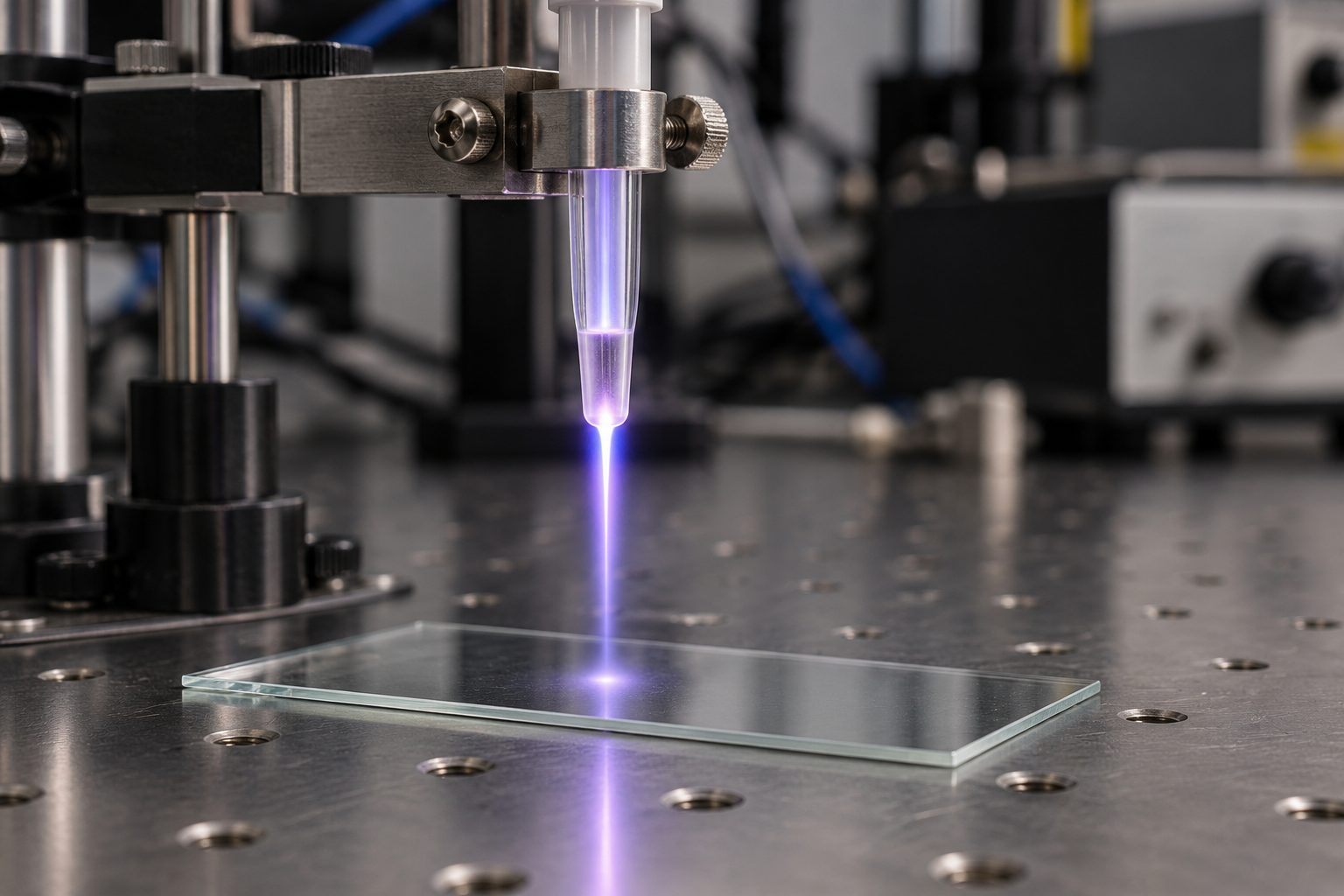
The sterilizer also illustrates why “plasma” does not specify a single recipe or purpose. The gas, pressure, energy source, temperature, and the surface being treated all matter. A cold atmospheric plasma source used in research on living tissue has a different setting and intended interaction from an enclosed sterilization cycle. The shared word points to charged particles; it does not make the technologies interchangeable.
Sources & further reading
- About Plasmas and Fusion Princeton Plasma Physics Laboratory
- Hydrogen Peroxide Gas Plasma CDC
Prepared for the independent PSI Center reading library. About edition dates and source checking.
This explainer describes scientific principles. It does not assess individual treatment choices.