How can energy applied at the scalp or inside the skull change brain activity? Brain stimulation techniques use electrical currents or changing magnetic fields to influence neurons and the circuits they form. The energy does not act as a single universal switch: electrode placement, field strength, pulse timing, and the targeted region all shape what happens. Comparing methods reveals why “brain stimulation” names a family of approaches with different procedures and evidence.
Electricity can reach the brain by different paths
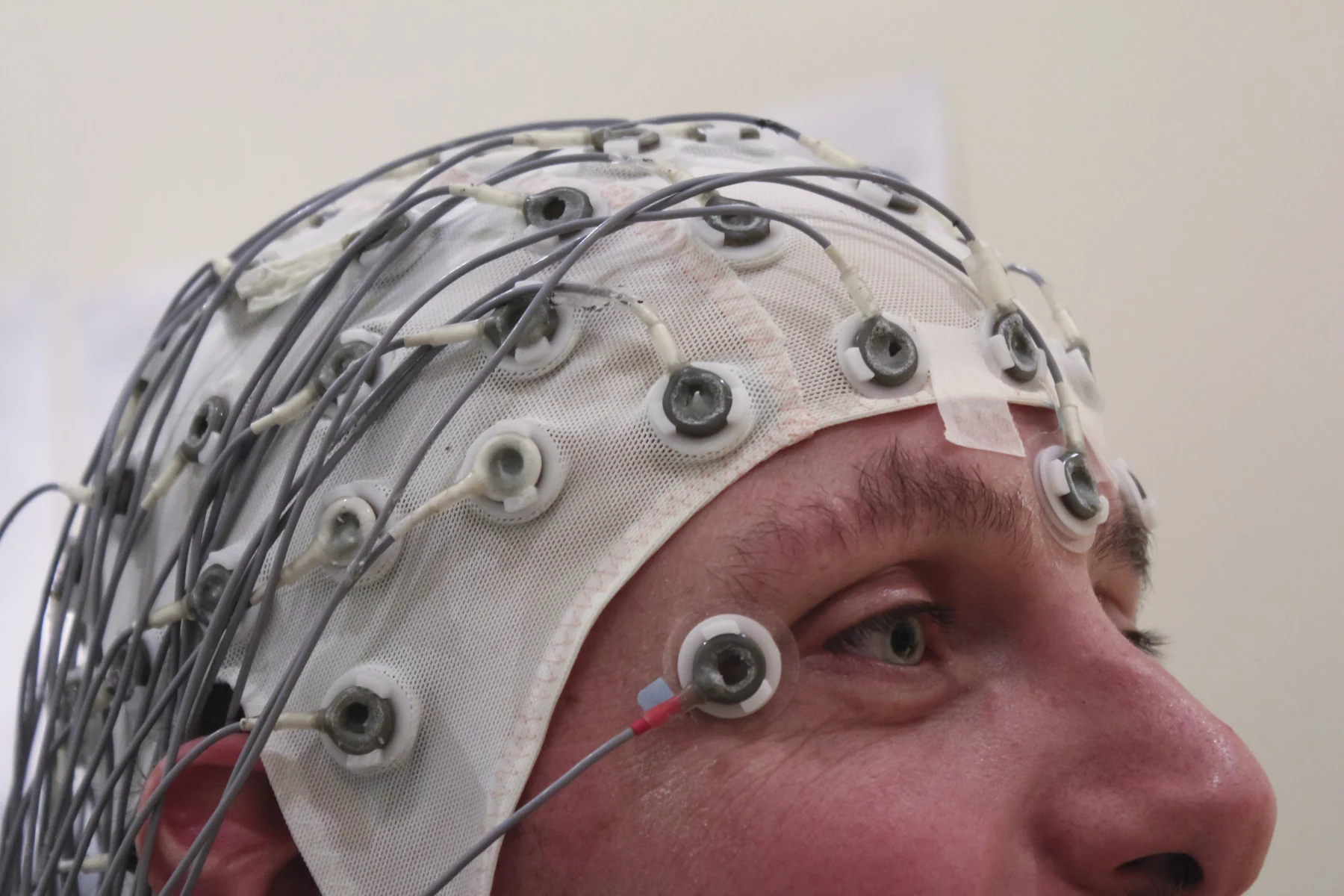
Some techniques place electrodes on the scalp, while others implant electrodes in the brain; magnetic stimulation applies a field to the head to induce electrical currents indirectly [1]. In an implanted system, electrodes deliver electrical pulses close to selected neural tissue. The immediate physical event is local: charge moves through tissue and changes the electrical environment around neurons, cells that communicate through electrical and chemical signals.
Deep brain stimulation illustrates the difference between stimulation and a cure. It uses implanted electrodes and a device, but NIMH lists deep brain stimulation among experimental brain stimulation therapies for mental disorders; research continues on its use and effectiveness in that context [1]. This status should not be generalized to every use of implanted stimulation for every condition. A device’s existence, or a plausible mechanism, does not by itself establish clinical benefit for a particular application.
A changing magnetic field can induce current
Repetitive transcranial magnetic stimulation, or rTMS, uses a coil near the head. Rapidly changing magnetic fields pass through the skull and induce weak electrical currents in targeted brain regions. The field itself is not an electric current delivered through a scalp electrode; it is the changing magnetic field that generates current in nearby conductive tissue [1]. This is an example of electromagnetic induction, the same broad physical principle behind generators.
A useful mental experiment is to imagine a magnetic field being switched on and off near a loop of wire: the changing field can drive current in the loop. Brain tissue is not a wire loop, and the biological geometry is more complex, but the analogy clarifies why a magnetic coil can produce electrical effects without touching the brain. rTMS is noninvasive and does not require anesthesia, unlike some other brain stimulation procedures [1].
Target and timing shape the effect
The induced current from rTMS is intended to stimulate a specific brain site, and pulses are repeated according to a treatment protocol. The location of the coil and the pattern of pulses matter because neural circuits are organized and connected; influencing one region can alter activity across a network. NIMH notes there is not consensus on the best coil positioning or pulse delivery for all purposes, and research continues to establish effective uses [1].
This is why “more energy” is not a useful shorthand for “more effect.” A brief, patterned input to one region may have a different outcome from a broader or prolonged input. Electrical stimulation can activate or inhibit brain activity depending on the method and settings [1]. The brain’s response is shaped by tissue properties and ongoing activity, not only by the energy source. Translating physical control into a reliable clinical outcome requires studies of both procedure and patient response.
Clinical evidence belongs to each method
Different methods have different standing. NIMH identifies electroconvulsive therapy, rTMS, and vagus nerve stimulation as authorized therapies for specified mental disorders, while deep brain stimulation and magnetic seizure therapy are categorized there as experimental approaches [1]. Those labels apply to the source’s stated context and should not be read as an all-purpose verdict about every device or indication. Authorization is specific to particular uses, and research remains active.
Non-ionizing electromagnetic fields are also distinct from ionizing radiation such as x-rays. Non-ionizing fields do not have enough energy to damage DNA directly in the way ionizing radiation can [2]. That physical distinction does not itself prove a therapy works or is risk-free; it describes an energy mechanism. For brain stimulation, careful control means specifying how energy is delivered and evaluating each technique in clinical studies. The path from a measurable current to a useful, safe treatment depends on evidence about outcomes, not physics alone [1] [2].
Sources & further reading
- Brain Stimulation Therapies NIMH
- Electromagnetic Fields and Cancer National Cancer Institute
Prepared for the independent PSI Center reading library. About edition dates and source checking.
This explainer describes scientific principles. It does not assess individual treatment choices.